

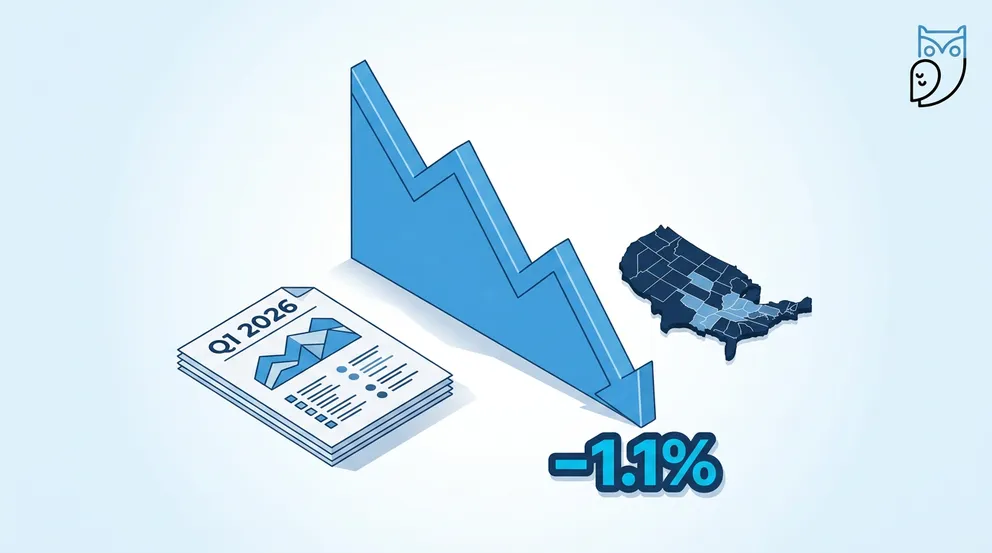
The Q1 2026 LexisNexis Insurance Demand Meter, released May 12, shifted from "Hot" to "Warm." U.S. auto insurance shopping grew just 3.2% year over year, the aggregate rate change across all carriers was -1.1%, and 35% of filed rate revisions cut premiums (averaging -5.1%) versus 39% that raised them (averaging 3.9%). The annual shop rate hit a record 47.3%.
U.S. auto insurance shopping growth slowed to 3.2% in the first quarter of 2026, with carriers filing more rate cuts than hikes for the first time in years, according to the LexisNexis Risk Solutions Q1 2026 Insurance Demand Meter released May 12, 2026. The aggregate rate change across all auto carriers landed at -1.1% for the quarter.
The shift signals a market turnaround. After two years of double-digit auto insurance rate hikes that pushed shopping activity to "Nuclear" and "Sizzling" levels, carriers have stopped racing to repair underwriting losses and started competing on price.
- Aggregate Q1 rate change of -1.1% (decreases averaged -5.1%, increases averaged 3.9%)
- Annual shop rate of 47.3% set a record since LexisNexis began tracking in 2020
- Shopping growth slowed to 3.2% year over year, down from 6.9% in Q4 2025
- Top 25 carriers cut rates in 42% of filings versus 26% that raised rates
- Direct-channel shopping grew 9.4%, while independent agent shopping fell 7.9%
Rate Cuts Now Outpace Hikes Among the Top 25 Carriers
Among all U.S. auto insurance rate revisions filed with state regulators in Q1 2026, 35% reduced premiums, 39% raised them, and 26% left rates flat, according to LexisNexis. The top 25 carriers tilted even further toward cuts. Their filings included 42% decreases, 26% increases, and 30% rate-neutral revisions.
The aggregate rate change of -1.1% marks a turning point versus 2023 and 2024, when Bureau of Labor Statistics data showed auto insurance premiums climbing more than 22% in a single year. Premiums remain elevated in absolute terms, but the momentum has reversed.
Drivers who locked in renewals during 2024 are now likely paying above current market rates. The average premium decrease of 5.1% translates to roughly $113 in annual savings on a $2,213 full-coverage policy, based on Insurify's 2026 national averages.
Why Shopping Cooled Even as Rates Dropped
Falling rates tend to suppress shopping activity. Drivers compare quotes when their bill spikes, not when it dips. LexisNexis confirmed the pattern in its Q1 report: rate decreases are less likely to trigger shopping than rate increases.
Three forces pushed shopping growth from 6.9% in Q4 2025 down to 3.2% in Q1 2026:
- Carrier rate decreases reduced premium-shock-induced switching activity
- Vehicle sales fell sharply in March 2026 compared with March 2025, when consumers rushed to buy ahead of potential auto tariffs
- Retention rates stabilized as carriers regained underwriting profitability
The baseline shopping volume remains historically high. By quarter-end, 47.3% of all auto policies in force had been shopped at least once in the prior 12 months, the highest annual shop rate LexisNexis has recorded since starting the metric in 2020.
State-by-State Shopping Breakdown
Only four states posted shopping growth of 10% or higher in Q1 2026, down from 11 states that cleared that threshold in Q4 2025. The leaders cluster in markets where rate-filing approvals run slowly and 2025 rate hikes are still rolling through renewal cycles.
| State | Q1 2026 Shopping Growth | Likely Driver |
|---|---|---|
| New York | 11.8% | Late-arriving 2025 rate hikes still hitting renewals |
| California | 10.4% | Slow Department of Insurance approvals delaying cuts |
| Wyoming | 10.1% | Smaller market reacting to premium pressure |
| Louisiana | 10.0% | Persistently high premiums driving comparison |
| New Jersey | 9.7% | Mixed carrier actions, just below threshold |
Source: LexisNexis Risk Solutions Q1 2026 U.S. Insurance Demand Meter, based on shopping data covering nearly 90% of U.S. consumer auto insurance shopping activity.
States where carriers filed cuts saw shopping fall closer to historical norms. New York and California stand out because their rate-filing review timelines push approvals out further, keeping older, higher premiums in force longer. Drivers in those two states are still chasing relief, even as the national average flips negative.
Who Is Shopping and Where They Are Going
Shoppers aged 66 and older led all age groups at 7.1% year-over-year growth, marking the 13th consecutive quarter that this cohort outpaced younger drivers. Buyers aged 26 to 35 saw shopping activity dip 0.3%. Drivers 36 to 45 rose 2.3%, and the 45-to-65 group grew 3.4%.
Channel data reveals where price-conscious drivers are heading:
- Direct carriers (GEICO, Progressive online, Liberty Mutual direct) grew 9.4%
- Exclusive agent carriers grew 5.6%, including State Farm, Farmers, and Allstate captives
- Independent agent channels contracted by 7.9%
- Non-standard carriers fell 5.8%, the first negative quarter since Q4 2023
The independent agent contraction is striking. Drivers comparing prices are bypassing local independent brokers and reaching for app-based quote tools first. The 7.9% decline in independent agent shopping suggests carriers like Travelers, Hartford, and Nationwide that distribute through that channel may need to compete harder in 2026.
"In this transitioning market, once loyal, profitable customers could be up for grabs. Insurers who recognize this can respond with compelling offers and personalized premiums to edge out competition," said Jeff Batiste, senior vice president and general manager of U.S. auto and home insurance at LexisNexis Risk Solutions.
What This Means for Your Next Renewal
Four scenarios shape what to do before your next renewal date:
Drivers in rate-cut states should expect a smaller renewal increase or possible decrease. Florida policyholders are already seeing 8% rate cuts in 2026, and Louisiana drivers benefited from 20 carriers filing rate decreases after tort reforms. Verify by pulling two or three competing quotes before accepting any renewal.
Drivers in New York, California, New Jersey, and Wyoming face continued upward pressure. Rate hikes are still cycling through. Direct-to-consumer carriers were 9.4% busier in Q1 because their pricing models update faster. New York drivers can read more about the state's $4,000/year insurance problem and reform efforts, and California shoppers face unique constraints under the state's rate-freeze legacy.
Customers of independent agents lost 7.9% of their channel's shopping volume in Q1. That agent will likely compete harder to keep your account. Ask directly for a re-quote and a multi-policy discount review.
Non-standard market drivers (those with DUI history, lapsed coverage, or SR-22 filings) face tighter conditions. The 5.8% drop in non-standard shopping suggests carriers raised underwriting bars. Quote out before assuming the switch will save money.
Check Your Current Rate
Log into your carrier portal or pull your renewal letter to confirm next-cycle pricing 30 days before the renewal date. Compare against the prior year's premium to see whether your carrier passed through a rate decrease.
Get Three Direct Quotes
GEICO, Progressive, and Liberty Mutual websites drove 9.4% of all 2026 shopping growth. Run each one. Drivers comparing carriers can start with our State Farm auto insurance review for the largest U.S. insurer or the GEICO auto insurance review for the leading direct carrier.
Enroll in Telematics
Programs like Drive Safe & Save, Snapshot, and DriveEasy can deliver 5% to 30% in safe-driver discounts. Personalized telematics-based pricing is becoming central to underwriting at major carriers.
Pull an Exclusive-Agent Quote
State Farm and Farmers grew 5.6% in Q1 partly because their multi-policy bundling pulls in home and auto together. Add up the combined savings versus splitting carriers.
Looking Ahead at the Rest of 2026
LexisNexis forecasts shopping growth could keep cooling through 2026 as rate cuts spread across more states. Retention is stabilizing, which makes 2026 a defensive year for insurers. The shift toward retaining existing customers points to more carrier-led savings offers, expanded discount catalogs, and faster pricing personalization through telematics data.
State filings in Q2 will indicate whether the carrier pull-back accelerates. With the top 25 carriers cutting rates 42% of the time, more decreases are likely through mid-2026. S&P Global pure-premium trend data shows medical and repair cost inflation has not vanished, so the rate cuts have a floor of roughly 5% to 6% off prior peaks.
For consumers, the takeaway is timing. Compare quotes within 60 days of your renewal even if your bill drops. The 5.1% average rate decrease applies only to filings already in effect, and your specific policy may not have repriced yet. Drivers who locked in 2025 renewals near the rate peak are most likely to find competitive offers waiting.
Frequently Asked Questions
The aggregate rate change across all U.S. auto insurers was -1.1% in Q1 2026, according to LexisNexis Risk Solutions. Rate decreases averaged 5.1% and rate increases averaged 3.9%. Among the top 25 carriers, 42% of filings cut rates and 26% raised them.
Rate decreases generate less shopping pressure than rate increases. When a renewal bill drops, drivers tend to stay put. LexisNexis confirmed this dynamic in its Q1 2026 report. Year-over-year shopping growth slowed to 3.2% from 6.9% in Q4 2025.
New York led with 11.8% year-over-year shopping growth, followed by California at 10.4%, Wyoming at 10.1%, and Louisiana at 10%. New Jersey came in just below the threshold at 9.7%. These five states had rate hikes still cycling through renewals from 2025 filings.
The LexisNexis U.S. Insurance Demand Meter is a quarterly analysis of auto insurance shopping volume and new policy growth. It is based on consumer shopping data representing nearly 90% of U.S. insurance shopping activity. LexisNexis has tracked the metric since 2020.
Yes. Even with falling rates, the average 5.1% decrease may not reach your specific policy until your renewal. Direct-to-consumer carriers grew 9.4% in Q1, signaling price-competitive options are available. Compare at least three quotes before each renewal cycle.
- LexisNexis Risk Solutions - Q1 2026 U.S. Insurance Demand Meter Press Release (May 12, 2026)
- Insurance Business America - US Auto Insurance Shopping Cools from "Hot" to "Warm" in Q1 2026
- LexisNexis Risk Solutions - Insurance Demand Meter White Paper Library
- Yahoo Finance - Auto Insurance Shopping and New Policy Growth Registers Warm on Q1 LexisNexis Demand Meter
- Bureau of Labor Statistics - Consumer Price Index for Motor Vehicle Insurance
- Insurify - 2026 National Auto Insurance Average Rates