
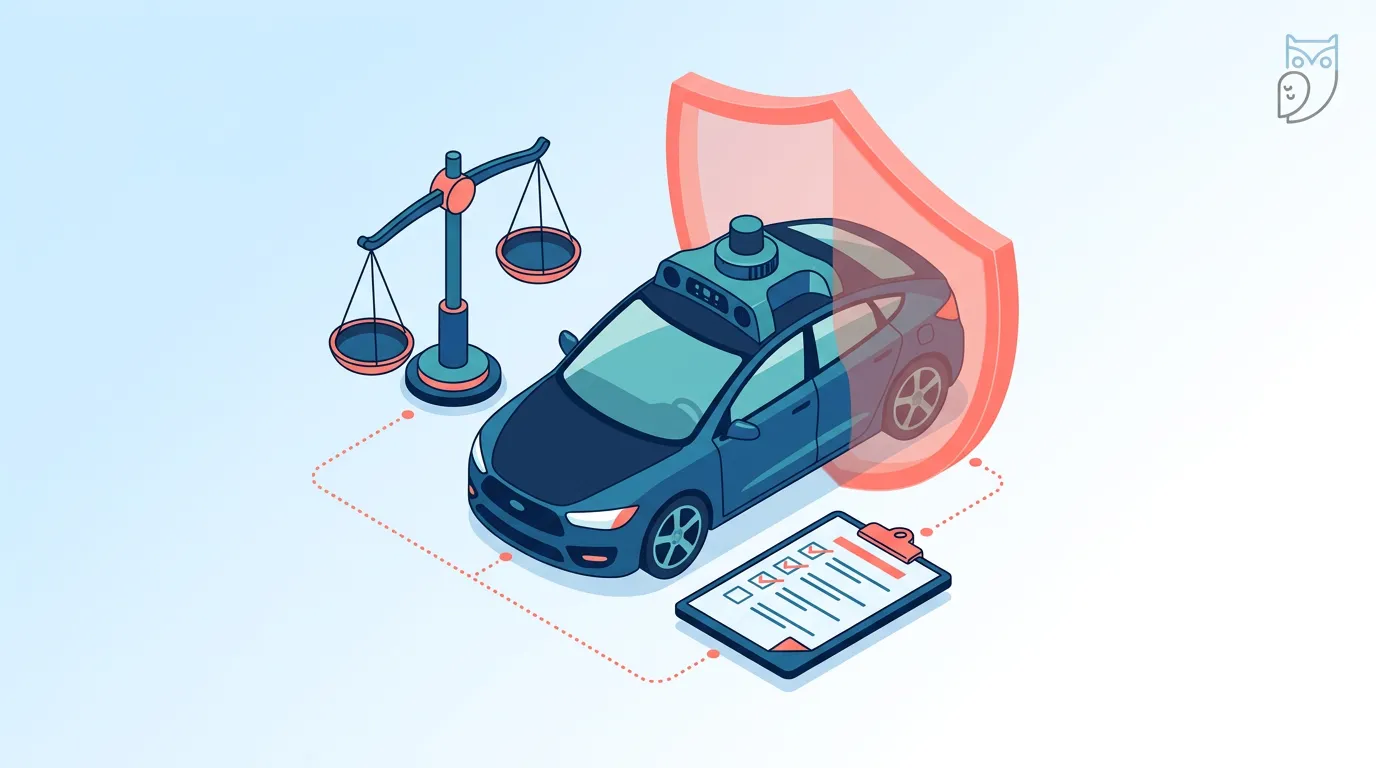
In 2026, the best insurance options for self-driving and autonomous vehicles depend on your car's automation level. For Tesla FSD drivers, Lemonade now offers a dedicated policy with a 50% per-mile discount when FSD is active. Commercial AV operators can tap into Uber Autonomous Solutions or Autonomy Insurance Services (Koop). Traditional insurers like Progressive and State Farm still cover Level 2 vehicles under standard auto policies — no special coverage required yet.
- Lemonade launched Tesla FSD-specific insurance in January 2026, with usage-based pricing tied directly to FSD mileage.
- Waymo vehicles operate under a fleet insurance model — individual owners don't need personal AV policies.
- As automation increases, liability shifts from the driver toward the manufacturer and software developer.
- California requires a $5 million insurance bond to test or operate AVs — the most restrictive state rule in the country.
- Goldman Sachs projects insurance costs will drop more than 50% over the next 15 years as AV safety data matures.
- Cyber liability coverage is emerging as a critical — and often overlooked — component of AV insurance.
Self-driving cars have moved from science fiction to your neighborhood streets. Waymo robotaxis are picking up passengers in San Francisco and Phoenix. Tesla owners are letting their cars navigate highways hands-free. And somewhere in a lab right now, an engineer is teaching a vehicle to handle a four-way stop better than your average teenager.
But here's the question nobody asked until the first fender bender: Who pays when a self-driving car crashes?
The insurance industry is scrambling to answer that — and honestly, they're still figuring it out. Let's break down exactly where things stand in 2026, which insurers are stepping up, and what you actually need to protect yourself.
Why AV Insurance Is Different From Regular Car Insurance
Standard auto insurance assumes a human is behind the wheel making decisions. You swerve, you brake, you misjudge the gap — and your liability coverage kicks in. Simple enough.
With autonomous vehicles, that assumption breaks down fast. If the software decides to change lanes and causes a crash, is that your fault? What if a hacker remotely interferes with the system? What if the sensors fail in fog?
These aren't hypotheticals anymore. They're questions insurers, regulators, and courts are actively working through right now.
Here's the deal: the insurance world is splitting AV liability into two distinct buckets — driver liability (traditional coverage) and product liability (manufacturer/software developer). The more autonomous the vehicle, the more responsibility shifts to the product side.
Automation Levels: Who's Liable at Each Stage?
The SAE defines six levels of driving automation, from 0 (fully manual) to 5 (fully autonomous). Knowing where your car falls determines who's on the hook when something goes wrong.
| SAE Level | What It Means | Examples | Primary Liability |
|---|---|---|---|
| Level 2 — Partial Automation | Car can steer and accelerate, but driver must stay alert | Tesla Autopilot, GM Super Cruise, Ford BlueCruise | Driver remains fully responsible |
| Level 3 — Conditional Automation | Car handles driving in defined conditions; driver must be ready to take over | Mercedes DRIVE PILOT (limited availability) | Shared — manufacturer begins sharing liability |
| Level 4 — High Automation | No driver intervention needed within defined areas (geofenced zones) | Waymo One, Cruise (paused), Zoox | Manufacturer and/or ADS provider bears primary liability |
| Level 5 — Full Automation | No driver needed, anywhere, anytime | Not commercially available yet | Manufacturer/software developer bears full liability |
Volvo and Mercedes have already made a bold move here — they've publicly stated they'll accept liability when their full self-driving systems are engaged. That's not just a PR statement; it changes how insurance is structured at the corporate level.
If you drive a Tesla with Autopilot or Full Self-Driving enabled, you're still at a Level 2 vehicle legally. You're required to maintain attention and control at all times. Your standard auto insurance covers you — but Lemonade's new FSD-specific policy could save you money if you use FSD frequently on longer drives.
Best Insurance Providers for Self-Driving Cars in 2026
Let's get into the actual options you have right now. The market is moving fast, and a handful of insurers are leading the charge while the traditional giants hold their position.
1. Lemonade — Tesla FSD-Specific Insurance
Lemonade made headlines in January 2026 by launching the first insurance product designed specifically for Tesla Full Self-Driving. And it's actually pretty clever.
Here's how it works: Lemonade integrates directly with your Tesla to track how many miles you drive using FSD. When FSD is active, you get a 50% discount per mile compared to your standard rate. Drive 60 miles on Autopilot to work? You're paying half-price for that stretch.
The policy launched in Arizona and is rolling out to Oregon on February 26, 2026. More states are expected throughout the year.
This is a usage-based model that finally aligns insurance cost with actual risk. If the car is driving itself — and statistically doing it better than you would — why should you pay the same premium?
2. Autonomy Insurance Services (Koop) — The Singularity Package
Koop targets AV companies, fleet operators, and technology developers rather than individual consumers. Their flagship product is the Singularity Package — a comprehensive bundle of six coverage types engineered specifically for the autonomous vehicle ecosystem.
What's included:
- General Liability — third-party bodily injury and property damage
- Errors & Omissions (E&O) — software mistakes and professional errors
- Cyber Liability — hacking, data breaches, ransomware attacks on vehicle systems
- Commercial Auto — on-road coverage for AV fleets
- Equipment Coverage — sensors, LiDAR, cameras, onboard hardware
- Excess Liability — additional limits beyond primary policies
Policy limits run from $1 million to $25 million. If you're a startup building AV software or running a robotaxi fleet, this is the kind of comprehensive package you need before you can even think about commercial deployment.
3. Uber Autonomous Solutions — Industry-First Program
Uber launched its Autonomous Solutions insurance program in 2026 as what the company calls an industry-first initiative. The program covers the full ecosystem of parties involved in autonomous vehicle operations:
- Manufacturers (the company that built the vehicle)
- ADS (Automated Driving System) providers
- Vehicle owners
- Fleet managers
One thing that makes this program notable is its scenario-specific coverage: on-trip, off-trip, and depot charging scenarios are all addressed. That matters enormously for commercial fleet operators who need continuous coverage across the full vehicle lifecycle — not just when it's picking up passengers.
4. Waymo — Fleet Insurance Model
Waymo doesn't sell cars to consumers, so there's no "Waymo insurance" for individual owners. Instead, Waymo operates its Level 4 vehicles under a fleet insurance model — similar to how taxi and rideshare fleets are insured as groups rather than individual vehicles.
The data on Waymo's safety record is genuinely remarkable. Swiss Re's December 2024 analysis found that Waymo vehicles produce 92% fewer bodily injury claims and 88% fewer property damage claims than comparable human-driven vehicles. Waymo also logged 78% fewer injury-causing crashes than the average human driver.
Those numbers are transforming how the insurance industry thinks about AV risk modeling. It's hard to argue with that data — and underwriters are starting to price accordingly.
5. Traditional Insurers — Progressive, State Farm, and Others
If you drive a Level 2 vehicle today — Tesla Autopilot, GM Super Cruise, Ford BlueCruise — your existing car insurance already covers you. As of June 2025, NHTSA has not issued additional federal requirements for Level 2 automation.
Progressive and State Farm haven't introduced special AV policy products yet. But they're not ignoring the space either. Both insurers are investing heavily in telematics data and watching the Waymo/Uber safety data closely. Their pricing models will shift as the actuarial picture becomes clearer.
Bottom line: if you have a standard vehicle with driver-assist features, stick with your current insurer. You're covered.
Even if your Tesla drives itself 90% of the time, you are legally considered the driver under current law in most states. If your Autopilot causes a crash while you're watching a video, your insurer may have grounds to dispute the claim. Always stay alert — and read your policy's fine print on driver-assist systems.
Comparing AV Insurance Providers at a Glance
| Provider | Who It's For | Coverage Type | Key Feature | Availability |
|---|---|---|---|---|
| Lemonade | Tesla FSD owners | Personal auto (usage-based) | 50% per-mile discount when FSD active | Arizona; Oregon Feb 2026 |
| Autonomy (Koop) | AV companies, fleet operators | 6-policy commercial bundle | $1M–$25M limits; cyber + E&O included | Commercial/B2B nationwide |
| Uber Autonomous Solutions | AV manufacturers, fleet managers | Commercial fleet | Covers on-trip, off-trip, depot charging | Commercial/B2B |
| Waymo (fleet model) | Waymo fleet vehicles (not consumers) | Fleet/commercial | Insured as fleet groups, not individual cars | Waymo operational markets |
| Progressive / State Farm | Level 2 AV drivers | Standard personal auto | No additional requirements for driver-assist | Nationwide |
What Coverage Types Do Self-Driving Cars Actually Need?
Traditional auto insurance was designed around one thing: human error. AV insurance has to cover a much wider universe of risk.
Product Liability
This covers failures in the vehicle's software or hardware systems. If the AV's perception system misidentifies a pedestrian and causes a crash, product liability is the coverage that matters. This is where the liability shift from driver to manufacturer becomes critical.
Cyber Liability
This is the one most people overlook. Autonomous vehicles are rolling computers — they run complex software, communicate with external networks, and depend on over-the-air updates. Hacking, ransomware, or a data breach in the vehicle's onboard systems could be catastrophic. Cyber liability coverage addresses exactly this risk.
Errors & Omissions (E&O)
Relevant primarily for AV developers and companies, E&O coverage protects against claims arising from professional errors or failures in the automated system design and deployment.
Commercial Auto
For any vehicle operating in a commercial capacity — robotaxis, delivery AVs, fleet vehicles — commercial auto coverage is non-negotiable.
Equipment Coverage
LiDAR sensors can cost $10,000 or more. Cameras, radar arrays, onboard computing hardware — these components are expensive and not always covered under standard collision coverage. Equipment coverage specifically addresses this gap.
State-by-State Regulations: What You Need to Know
Let's be honest — the regulatory landscape for AVs is a patchwork quilt right now. There's no unified federal framework, so states are setting their own rules. Here's what matters most by state:
California — Most Restrictive
California requires a $5 million insurance bond for any company testing or operating autonomous vehicles on public roads. This is by far the highest threshold in the country. The California DMV and CPUC both have active regulatory authority over AV operations, and the permitting process is thorough.
Florida — Moderate Requirements
Florida mandates a $1 million minimum insurance requirement for fully autonomous vehicles. Florida was actually an early mover in AV legislation and has a relatively welcoming regulatory environment compared to California.
Arizona & Texas — AV-Friendly
Both states have deliberately cultivated less restrictive environments to attract AV development and testing. Arizona is home to Waymo's primary robotaxi service and serves as Tesla's FSD testing hub — which is why Lemonade launched its FSD insurance there first. Texas similarly has a light-touch approach to AV regulation.
Federal (NHTSA) — Still Evolving
As of June 2025, NHTSA has not issued additional federal insurance requirements for Level 2 automation. The agency is actively exploring standardized rules for higher automation levels, but federal framework for Levels 3–5 is still in development. Watch this space — federal guidance will eventually supersede the current patchwork of state rules.
If your company is developing or deploying AV technology and you're considering where to operate, Arizona and Texas offer the lowest regulatory friction. California offers the most developed legal framework — which can actually be an advantage if you need clear rules to plan around.
What the Future of AV Insurance Looks Like
Here's where things get genuinely exciting. Goldman Sachs projects that insurance costs for autonomous vehicles will drop from $0.50 per mile in 2025 to $0.23 per mile by 2040 — a decrease of more than 50%. That's driven almost entirely by the safety data that's starting to emerge from Waymo, Cruise, and others.
Think about what a 92% reduction in bodily injury claims actually means for actuarial tables. It fundamentally rewrites the risk model. Insurers who can accurately price AV risk early will capture enormous market share. Those who lag will lose ground to tech-native players like Lemonade who are already integrating directly with vehicle systems.
We're also likely to see a shift from personal auto insurance toward product liability models as automation levels rise. The day Level 5 vehicles become commercially available, personal auto insurance as we know it may become largely irrelevant for the people riding in them.
Distracted driving alone caused 3,275 deaths in the United States in 2023. If AVs eliminate even a significant fraction of that, the human cost savings dwarf the insurance cost savings. That's the bigger picture.
Frequently Asked Questions
Not necessarily, but it can save you money if you use FSD regularly. Tesla FSD is a Level 2 system, which means your standard auto insurance covers you. However, Lemonade's new FSD-specific policy (launched January 2026 in Arizona, expanding to Oregon) offers a 50% per-mile discount when FSD is active. If you're logging a lot of FSD miles, this usage-based approach could lower your total insurance cost significantly.
It depends on the automation level. For Level 2 vehicles (Tesla Autopilot, Super Cruise), the driver remains legally responsible — even if the car was doing the driving. At Level 3, liability begins to shift toward the manufacturer in certain conditions. For Level 4 and above, the vehicle manufacturer or automated driving system (ADS) provider bears primary liability. Volvo and Mercedes have already publicly committed to accepting liability when their systems are fully engaged.
For Level 2 vehicles, yes — standard liability and collision coverage applies. But standard policies weren't designed with AV-specific risks in mind. Software failures, cyber intrusions, and sensor malfunctions may fall into gray areas depending on your policy language. If you're operating in a commercial AV capacity, you'll almost certainly need specialized coverage like what Koop's Singularity Package or Uber Autonomous Solutions provides.
As of 2026, Arizona, Texas, California, and Florida all permit AV operations with varying requirements. California is most restrictive, requiring a $5 million insurance bond for testing and operation. Florida requires $1 million minimum coverage. Arizona and Texas have more permissive frameworks that have made them leading hubs for AV development and deployment. Most other states are in the process of updating their statutes as AV technology matures.
Almost certainly, yes. Goldman Sachs projects more than a 50% reduction in insurance costs per mile over the next 15 years — from $0.50/mile in 2025 to $0.23/mile by 2040. Waymo's real-world data already shows 92% fewer bodily injury claims than human drivers. As that safety track record grows and actuarial models incorporate AV-specific data, premiums should drop substantially. Early adopters may benefit from usage-based policies (like Lemonade's FSD discount) before industry-wide pricing adjusts.
- Swiss Re — Waymo AV Safety Analysis, December 2024
- Goldman Sachs — Autonomous Vehicle Insurance Cost Projections
- NHTSA — Automated Vehicles Safety Overview (updated June 2025)
- Lemonade — Tesla FSD Insurance Launch, January 2026
- Koop (Autonomy Insurance Services) — Singularity Package
- Uber — Autonomous Solutions Insurance Program, 2026
- NHTSA Distraction.gov — Distracted Driving Statistics 2023
- California DMV — Autonomous Vehicle Regulations