

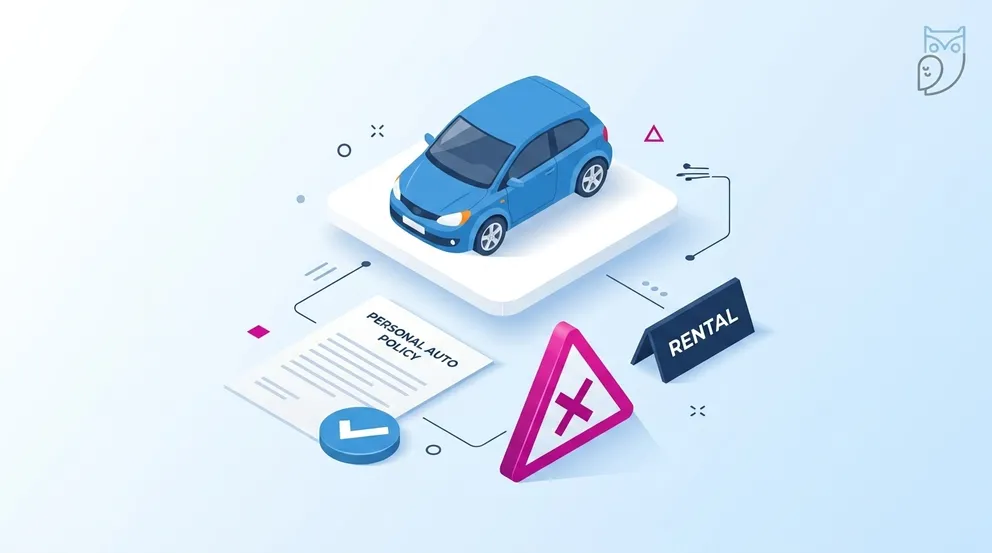
Yes, your personal auto policy usually covers rental cars in the US and Canada with the same liability, collision, and comprehensive limits you carry on your own car. Your deductible still applies, and most policies will not pay rental-company "loss of use" or administrative fees. Credit cards add a layer that covers physical damage to the rental, primary on Chase Sapphire Reserve and secondary on most other cards, per NerdWallet's 2026 review.
If you already pay for full coverage car insurance, you almost certainly do not need the package the rental counter agent is pressuring you to buy. The catch is that "almost certainly" hides three real gaps where you can owe Hertz or Enterprise thousands out of pocket. This guide walks through exactly what your policy pays for, where the holes are, and how credit card coverage closes most of them.
What Your Personal Auto Policy Covers in a Rental Car
Your personal auto insurance follows you into a rental car as long as you are driving a private passenger vehicle for personal use inside the United States or Canada, according to the Insurance Information Institute. The coverages transfer one-for-one with the limits and deductibles on your policy.
Three coverages do most of the work:
- Liability pays for injuries and property damage you cause to others. Your state minimum or whatever higher limit you carry applies. Texas drivers carrying 30/60/25 still have 30/60/25 in the rental.
- Collision pays to fix the rental car if you hit something. Your deductible (often $500 or $1,000) applies before the insurer pays anything.
- Comprehensive pays for hail, theft, vandalism, and animal strikes on the rental, also subject to your deductible.
If you carry liability only, you are exposed for damage to the rental itself. Drivers without collision and comprehensive on their own car get no help from their insurer for a dented bumper or stolen radio in the rental. The rental counter waiver becomes a real consideration in that scenario.
Personal injury protection and medical payments coverage also extend, which matters more in no-fault states where PIP pays your medical bills regardless of who caused the crash.
State minimum liability is almost never enough. California's 15/30/5 minimum covers $15,000 per person in bodily injury, well under the $30,500 average serious-injury settlement per Insurance Information Institute data. If you only carry minimums, a serious rental-car crash can leave you personally liable for the rest.
What Your Policy Won't Cover at the Rental Counter
Even drivers with rich full coverage policies face four specific gaps when the rental car is damaged or out of service. These are where the rental agency makes its money.
Loss of use fees. When a rental car sits in a body shop for two weeks, the rental company loses two weeks of revenue and bills you for it. A daily loss-of-use charge on a midsize sedan typically runs $30 to $70 per day. A 14-day repair produces a $420 to $980 bill on top of the collision repair itself. Most personal auto policies exclude loss-of-use payments entirely.
Diminished value. The rental car loses resale value once it has been in an accident, even after repair. Some rental companies bill renters for that diminished value. Personal auto policies almost never reimburse it.
Administrative and towing fees. Hertz, Enterprise, and Avis charge administrative fees of $50 to $250 to process an accident claim, plus towing and storage charges. Your insurer pays the repair but not the paperwork.
Business use. Personal auto policies exclude rentals used for work, including most rideshare and delivery driving. If you rent a car to drive for DoorDash or to make sales calls, your personal coverage does not apply per the standard ISO personal auto policy form.
International rentals are also out. Coverage stops at the US and Canadian borders for most carriers, so a rental picked up in Mexico City or London needs its own protection.
The rental contract you sign is enforceable even if your insurer disagrees with it. Loss-of-use and administrative fees are contractually owed to the rental company. If your insurer refuses to pay them, you owe them. Read the damage waiver section of the contract before signing.
Credit Card Rental Coverage: Primary vs. Secondary
Pay for the rental with a major credit card and you typically get a layer of physical-damage coverage thrown in for free. The catch is that most cards offer secondary coverage, which means it pays only after your personal auto policy pays first. A handful of premium cards offer primary coverage that lets you skip your auto insurer entirely.
According to NerdWallet's 2026 credit card rental coverage analysis and individual card benefits guides, the breakdown by major issuer looks like this.
| Card / Network | Primary or Secondary | Coverage Limit | Max Rental Days |
|---|---|---|---|
| Chase Sapphire Reserve | Primary | Up to $75,000 | 31 days |
| Chase Sapphire Preferred | Primary | Up to $75,000 | 31 days |
| Capital One Venture X | Primary | Vehicle value up to $75,000 | 15 days US, 31 international |
| Amex Platinum (free benefit) | Secondary | Up to $75,000 | 30 days |
| Amex Premium Car Rental Protection (paid) | Primary | Up to $100,000 | 42 days |
| Visa Signature / Infinite | Secondary | Actual cash value of vehicle | 15 days US, 31 international |
| Mastercard World / World Elite | Secondary | Up to $50,000 | 15 days US, 31 international |
Source: NerdWallet 2026 credit card rental coverage analysis, individual card benefits guides from Chase, American Express, Visa, and Mastercard. Coverage varies by card tier within each issuer; always confirm with your card's Guide to Benefits before relying on it.
Primary coverage is more valuable than the label suggests. With secondary coverage, you must file a claim with your auto insurer first, which can raise your premium 15% to 30% per Quadrant data on at-fault claims. Primary coverage lets the card issuer pay the full repair bill without touching your auto policy, so your premium stays flat.
American Express sells primary upgrade coverage called Premium Car Rental Protection for $12.25 to $24.95 per rental period (not per day), depending on your state of residence. For a week-long rental in a luxury SUV, that is roughly the cost of one day of the rental counter waiver.
Most credit card coverage excludes specific vehicle classes and countries. Mastercard does not cover vehicles built for more than nine passengers. Visa and Mastercard standard coverage excludes rentals in Ireland, Israel, and Jamaica. Amex excludes Italy, Australia, and New Zealand. Exotic and antique cars are off-limits on most cards.
To activate credit card coverage, you have to decline the rental counter collision damage waiver and charge the full rental to the card whose protection you want to use. Putting the deposit on one card and the final bill on another can void coverage.
The Four Rental Counter Add-Ons, Decoded
The agent at the Hertz counter will offer four products with three-letter acronyms. Each one duplicates something you may already have. Average daily costs based on MoneyGeek and WalletHub 2026 rental insurance reports are below.
| Add-On | Cost Per Day | What It Covers | Already Have It? |
|---|---|---|---|
| Collision Damage Waiver (CDW) / Loss Damage Waiver (LDW) | $15-$30 | Damage and theft of the rental car, loss-of-use fees | Partial: your collision/comp covers damage, but not loss-of-use |
| Supplemental Liability Insurance (SLI) | $10-$15 | Up to $1 million in liability above the state minimum included in the rental rate | Yes, if you carry 100/300/100 or higher liability |
| Personal Accident Insurance (PAI) | $5-$10 | Medical bills and accidental death for you and passengers | Yes, through health insurance, PIP, or MedPay |
| Personal Effects Coverage (PEC) | $2-$5 | Stolen personal belongings from the rental car | Yes, renters or homeowners insurance covers off-premises theft |
Source: MoneyGeek 2026 rental insurance cost report and WalletHub 2026 rental car insurance guide. Daily rates vary by city, rental company, and vehicle class; expect higher prices in airport locations and on luxury vehicles.
Bundled together, these four add-ons average $61 per day per MoneyGeek's 2026 data. On a one-week rental, that is $427 layered on top of the base rental rate. For most drivers with full coverage and a major credit card, the only piece worth considering is the CDW for its loss-of-use protection.
Personal Policy vs. Credit Card vs. Rental Counter
The three coverage sources work in layers. Here is how they stack up for the same scenario: you rent a $35,000 midsize SUV for seven days and a fender-bender causes $4,500 in damage plus $700 in loss-of-use fees.
| Coverage Source | What It Pays | Your Out-of-Pocket |
|---|---|---|
| Personal auto policy only (with $500 deductible) | $4,000 toward repair | $500 deductible + $700 loss-of-use = $1,200 |
| Personal policy + secondary credit card coverage | $4,000 from auto policy, $500 deductible from card, some loss-of-use | $0-$300, depending on card |
| Primary credit card coverage (Chase Sapphire Reserve) | $4,500 repair + loss-of-use, paid by card issuer | $0, no claim on auto policy |
| Rental counter CDW only ($25/day x 7 = $175) | Full repair + loss-of-use, no deductible | $175 (the CDW cost itself) |
Illustrative example based on industry-average deductibles, loss-of-use fees, and CDW pricing. Real-world outcomes depend on your specific policy limits, deductible, credit card benefits guide, and the rental contract's damage waiver terms.
The numbers explain why credit card coverage has eaten so much of the rental insurance market. A free secondary benefit on a card you already carry erases most of the gap, and a primary benefit on a Chase Sapphire Reserve or Capital One Venture X erases it entirely without filing an auto claim that could raise your deductible structure or push you toward a rate hike.
When You Should Pay for Rental Counter Coverage
Skip the counter pitch in most cases. Buy it in five specific situations.
You only carry liability on your own car
No collision or comprehensive on your personal policy means no help from your insurer for damage to the rental. The CDW becomes your primary protection. Buy it, or upgrade your personal policy to full coverage before the trip.
You don't own a car at all
Without a personal auto policy, you have no liability or physical damage coverage on the rental. A non-owner policy costs $200 to $500 per year and covers the liability piece, but you still need the CDW for damage to the rental car itself.
You are renting internationally
US auto policies and most credit card benefits stop at the border. Rentals in Mexico, Ireland, Israel, Jamaica, Italy, Australia, and New Zealand all need locally-purchased coverage or a specialty travel insurance policy.
You're renting a luxury, exotic, or specialty vehicle
Credit card coverage caps and rental classes exclude vehicles over a certain value, plus motorcycles, trucks over a certain weight, and exotic cars. A $250,000 Lamborghini rental needs the rental company's coverage; your credit card will not touch it.
An accident would push you into a rate hike you can't afford
A single at-fault claim can raise rates 40% to 50% for three to five years per NAIC data, equal to thousands of dollars in extra premium. If you are already at-risk for non-renewal or paying surcharged rates, the CDW lets you handle damage without touching your auto policy at all.
For everyone else with full coverage and a major credit card, the rental counter package is largely duplicate coverage. Decline it, charge the rental to your card, and rely on the layered protection you already pay for.
Lying about who is driving is insurance fraud. Adding a spouse or friend as an authorized driver at the counter usually costs $10 to $15 per day extra. Letting an unauthorized driver behind the wheel voids both the rental contract and your auto policy coverage if there is a crash. Worth the add-on cost.
Frequently Asked Questions
Yes, personal auto insurance follows you into a rental car in the US and Canada with the same liability, collision, and comprehensive limits you carry on your own car, per the Insurance Information Institute. Your deductible still applies, and the rental must be a private passenger vehicle used for personal purposes.
Filing an at-fault claim on a rental can raise your premium 40% to 50% for three to five years per NAIC data, the same as a claim on your own car. Comprehensive claims (theft, hail) usually do not affect rates as much. Primary credit card coverage avoids the auto-policy claim entirely.
Only a few cards offer primary coverage, including Chase Sapphire Reserve, Chase Sapphire Preferred, Capital One Venture X, and Amex Premium Car Rental Protection (paid upgrade). Most cards offer secondary coverage that pays only after your auto policy. To use the benefit, charge the full rental to the card and decline the rental counter waiver.
Usually not for the basic CDW. Full coverage and a major credit card cover the major risks. Consider the CDW if you would otherwise owe loss-of-use fees out of pocket, if you are driving for work, or if a claim would push you into a rate hike you cannot afford.
No. Personal auto policies exclude business use of a rental, including rideshare, delivery driving, and most work travel. Buy the rental counter's commercial liability and CDW if your employer is not providing a corporate auto policy.
Loss of use is the daily revenue a rental company loses while a damaged car sits in the shop, typically $30 to $70 per day. Most personal auto policies explicitly exclude these payments, even though they are contractually owed to the rental company. The CDW covers them; many credit card benefits also include loss-of-use reimbursement.
The rental counter pitch costs an average $61 per day. Your full coverage policy plus any major credit card cover most of what it promises. Spend two minutes reading your card's benefits guide before the next trip and you can probably skip the pitch entirely.
One last note. If your trip puts your own car in the shop and you need a rental to commute or run errands, that is a different product called rental reimbursement coverage, an add-on on your personal policy that pays $30 to $50 per day for a substitute car. It has nothing to do with insuring a rental you drive on vacation, but it is the source of constant confusion at renewal time.
- Insurance Information Institute: What Coverage Do I Need for a Rental Car?
- MoneyGeek: Rental Car Insurance: What Does It Cover? (2026)
- WalletHub: Rental Car Insurance Key Things to Know in 2026
- NerdWallet: Rental Car Insurance and How Your Credit Card Covers You
- ConsumerAffairs: Does Car Insurance Cover Rental Cars (2026 Guide)
- American Express: The Benefits of Credit Card Rental Car Insurance
- NAIC: Auto Insurance Database Report