

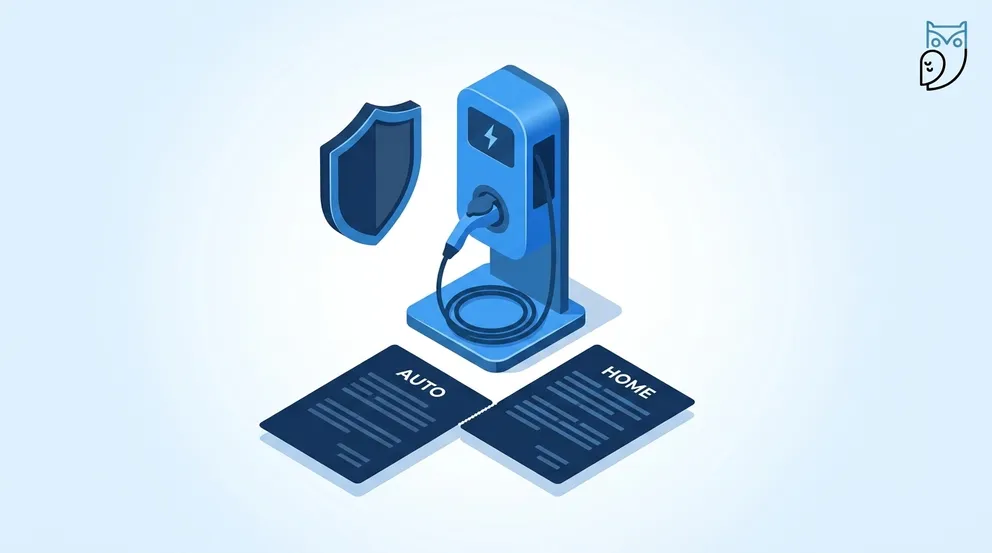
Whether your car insurance covers a home EV charger depends on installation. A hardwired Level 2 unit is usually covered by homeowners insurance as part of your dwelling, while a portable charger or its cable falls under comprehensive auto insurance, per State Farm and Allstate 2026 guidance.
About 80% of EV charging happens at home, according to the U.S. Department of Energy, so most owners plug into equipment that sits in a gray zone between two policies. A wall-mounted Level 2 charger gets treated as part of your house. The cord set you keep in the trunk gets treated as part of your car. Misread that line and you can file an EV charging coverage car insurance claim under the wrong policy, pay a deductible that wipes out the payout, or collect nothing at all.
- Hardwired Level 2 chargers usually fall under homeowners insurance as part of the dwelling, per Mercury Insurance
- Portable chargers and the cable that came with your car are typically covered by comprehensive auto insurance
- The federal 30C tax credit pays back 30% of installation costs up to $1,000, but it expires for equipment placed in service after June 30, 2026, per the IRS
- A $1,500 charger behind a $1,000 deductible nets just $500 on a claim, so the math rarely favors filing
Hardwired or Portable: The Split That Decides Which Policy Pays
One question settles most coverage disputes: is the charger attached to your house or to your car? Insurers draw the line there because a standard homeowners policy excludes motor vehicles and their equipment, accessories, and parts, as Mercury Insurance spells out. A hardwired Level 2 wallbox bolted to your garage reads as a fixture of the home. A 120-volt cord you unplug and carry reads as gear that belongs to the vehicle.
That distinction changes the deductible you pay, the limit that applies, and which adjuster picks up the file. Run your situation through the table below before you call anyone.
| Scenario | Likely Policy | Why |
|---|---|---|
| Hardwired Level 2 unit destroyed in a house fire | Homeowners (dwelling) | Permanently attached to the structure |
| Wall charger fried by lightning or a power surge | Homeowners | Surge and lightning are named perils for the dwelling |
| Portable Level 1 cord stolen from the garage | Homeowners contents or comprehensive auto | Classified as a movable item, not a fixture |
| Charging cable that shipped with the car is cut or stolen | Comprehensive auto | Treated as vehicle equipment |
| Your car is damaged at a public charging station | Comprehensive auto | Vehicle damage, not home equipment |
| Charger quits because of a manufacturer defect | Neither (manufacturer warranty) | Excluded by both policies |
| Unit fails after an unlicensed install | Neither | Faulty workmanship is excluded |
Source: State Farm, Allstate, SmartFinancial, and Mercury Insurance coverage guidance, 2026. Classification and limits vary by carrier and state, so confirm with your own policy.
When Homeowners Insurance Covers Your EV Charger
A permanently mounted Level 2 charger usually qualifies as part of your dwelling or other structures, which means your homeowners policy repairs or replaces it after a covered peril. Mercury Insurance confirms that hardwired stations are typically treated as part of the home and covered depending on the type and cause of loss. Fire from an electrical malfunction, a lightning strike, a windstorm, hail, theft, and vandalism all generally qualify.
Fire is the loss that matters most here. SmartFinancial names fire as the biggest hazard with home charging stations, usually traced to outdated electrical infrastructure rather than the charger itself. If a short-circuited unit ignites and damages your garage, the structural repair runs through homeowners coverage, and the charger replacement rides along when it counts as dwelling property.
A standard homeowners policy excludes "motor vehicle equipment." If your insurer classifies the charger as vehicle gear rather than a fixture, the dwelling coverage you assumed applies may not. Ask your agent in writing how your specific charger is coded, and consider scheduling it as named property for full replacement value.
Coverage tightens the moment installation cuts corners. Damage from poor maintenance, normal wear and tear, or work done without a licensed electrician is commonly excluded, per SmartFinancial. Skipping the permit creates the same problem, because an adjuster can deny a later claim once unpermitted work surfaces. Keep the electrician's invoice and the inspection sign-off in the same folder as your policy. Bundling the charger conversation into your wider coverage review also helps, and our guide to bundling home and auto insurance shows where a single carrier can simplify a split claim like this.
When Comprehensive Car Insurance Covers It Instead
Comprehensive auto insurance steps in for the parts of your charging setup that travel. A portable charger is covered only by comprehensive, not homeowners, because it belongs to the car and can be used anywhere, per SmartFinancial. The same logic catches the cable that came bundled with your EV. Comprehensive coverage is the piece of your policy that pays for theft, vandalism, fire, and weather damage, so a stolen cord or a vandalized portable unit lands squarely inside it.
Cable theft is the fastest-growing claim in this category. The U.S. Department of Energy reports that thieves target charging cables for the copper inside, and rising copper prices have pushed incidents up as more EVs hit the road. A fully comprehensive policy in 2026 typically covers the cable against theft or damage, even when it is cut while the car is charging, though the insurer's classification of the cable as vehicle part versus accessory decides the outcome.
Comprehensive carries a deductible, usually $500 to $1,000. A $1,500 portable charger stolen behind a $1,000 deductible pays out just $500, and that single claim can raise your premium 10% or more at renewal. For anything under your deductible, paying out of pocket protects your record and your rate.
EVs already cost more to insure, which sharpens that calculation. Electric models run roughly 20% to 25% above comparable gas cars on premium, a gap detailed in our breakdown of car insurance rates by vehicle type. Adding small charger claims on top of a higher base rate compounds quickly, so reserve the comprehensive route for losses that clearly clear your deductible. Tesla owners weighing the same trade-offs can compare specifics in our Tesla car insurance guide.
What a Home Charger Costs and What's Never Covered
Knowing the replacement cost tells you which policy is worth involving. Most U.S. homeowners pay $1,200 to $3,000 for a professionally installed Level 2 charger in 2026 before incentives, with the hardware itself now in the mid-hundreds rather than the thousands. The variables that move the bill are your panel capacity, the wiring distance, and whether the unit sits indoors or out.
Source: 2026 installer pricing aggregated across U.S. estimates. Panel upgrades vary widely by home age and amperage.
The federal Section 30C credit covers 30% of equipment and installation up to $1,000 for qualifying residential installs, per the IRS. On a $2,500 install, that returns $750. The credit terminates for property placed in service after June 30, 2026, so installing this spring captures money that disappears at midyear.
Both policies share a list of exclusions worth memorizing. Manufacturer defects route to the warranty, never the insurer. Wear and tear, including damage from repeated freezing, is excluded as a maintenance issue. Faulty installation by an unlicensed contractor voids the claim, and intentional or negligent damage gets denied outright. Travelers offers an Energy Component Endorsement that pays for EV battery replacement even past 70% degradation, a reminder that the broader EV equipment niche increasingly needs named riders rather than assumed coverage.
How Major Carriers Handle EV Charger Coverage
Carriers diverge on whether a charger needs a dedicated endorsement, so the smart move is to ask before you install, not after a loss. Mercury recommends notifying your agent the moment the charger goes live so it can be added to the policy. Below is how four insurers currently approach home charging equipment.
| Carrier | How It Handles the Home Charger | Notable EV Provision |
|---|---|---|
| State Farm | Offers an endorsement for home, renters, condo, or auto policies | EVSE theft and damage rider |
| Mercury | Treats a hardwired unit as dwelling; asks you to notify your agent | Excludes the charger as vehicle equipment unless added |
| Lemonade | Covers a wall charger under homeowners property | Schedule it as named property for full value |
| Travelers | Covers structural EV equipment with riders | Energy Component Endorsement for battery degradation past 70% |
Source: State Farm, Mercury Insurance, SmartFinancial, and carrier endorsement guidance, 2026. Availability and limits vary by state; confirm terms directly with the insurer.
Two practical steps protect you regardless of carrier. Photograph the installed unit and save the licensed electrician's invoice, since proof of professional work is what keeps a claim alive. Then decide where the charger is best insured: a wall unit usually belongs on the homeowners side, while a portable cord follows the car, a split that mirrors the wider bundle versus separate policy decision. If you want the charger replacement counted toward your auto setup, confirm it falls inside your full coverage rather than assuming comprehensive picks it up.
Frequently Asked Questions
Comprehensive auto insurance covers portable chargers and the charging cable that came with your car, including theft and vandalism, per SmartFinancial. A hardwired wall unit usually falls under homeowners insurance instead, because it is attached to your house rather than your vehicle.
Yes, a permanently installed Level 2 charger is generally covered as part of your dwelling for perils like fire, lightning, theft, and vandalism, per Mercury Insurance. Damage from wear and tear, an unlicensed install, or a manufacturer defect is excluded.
Only comprehensive auto insurance covers a portable charger, not homeowners insurance, because it belongs to the car and can be used anywhere. With a $500 to $1,000 deductible, filing only makes sense when the charger's value clearly exceeds the deductible.
Yes. Mercury Insurance recommends notifying your agent as soon as the charger is installed so it can be added to your policy. Reporting the upgrade and keeping the licensed electrician's invoice prevents a denied claim later.
A comprehensive auto policy typically covers cable theft in 2026, even if the cable is cut while the car is charging, per the U.S. Department of Energy and SmartFinancial. Coverage depends on whether your insurer classifies the cable as a vehicle part or an accessory.
- State Farm: EV Home Charging and Homeowners Insurance
- Allstate: Does Insurance Cover Accidents Involving EV Charging Stations?
- SmartFinancial: Does Homeowners Insurance Cover Charging Stations?
- Mercury Insurance: Review Your Policy Before Charging an EV at Home
- U.S. Department of Energy: EV Charging Cable Theft
- IRS: Alternative Fuel Vehicle Refueling Property Credit (Section 30C)