

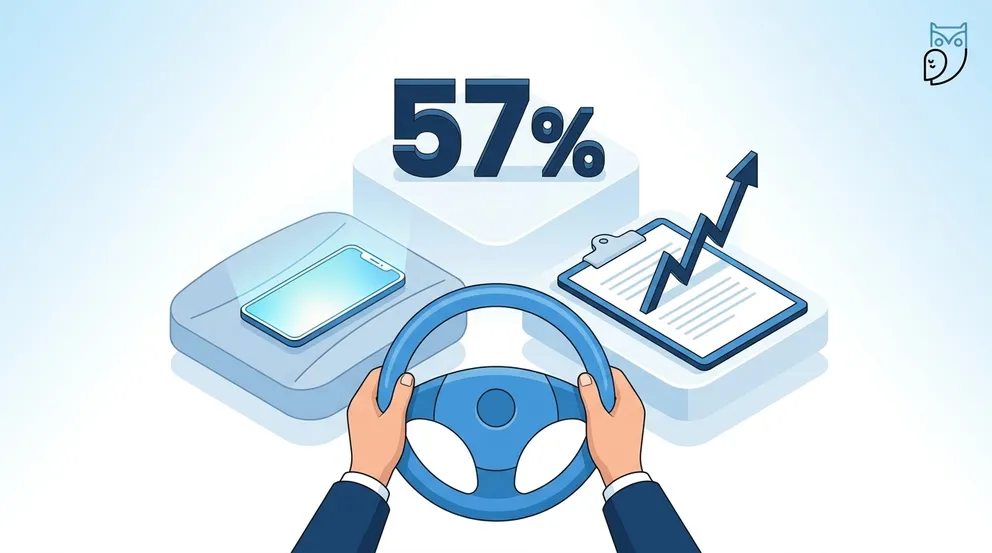
Distracted driving violations have jumped 57% since 2022, and bodily injury claims now consume more than 26% of every dollar U.S. auto insurers pay out, according to the 2026 LexisNexis U.S. Auto Insurance Trends Report released May 19. Both trends push premiums higher in 2026, even for drivers who have never filed a claim.
LexisNexis Risk Solutions publishes the report every year, tracking driving behavior, policy shopping, vehicle mix, and claims data across the U.S. market. For consumers, the message is blunt: the loss costs that set your rate keep climbing, and carriers are filing for higher prices to match.
- Distracted driving violations rose 57% since 2022, with drivers ages 36 to 45 up 70% or more and drivers 66 and older up 73%.
- Bodily injury claims climbed from under 20% of claims dollars in 2022 to more than 26% in 2025.
- A single distracted-driving ticket raises premiums about 28% on average, roughly $600 a year, and stays on your record for three to five years.
- Shopping hit a record: 47% of policies-in-force pulled a new quote in the 12 months ending Q4 2025.
What the LexisNexis Report Found
The 57% spike in distracted driving is not a teenager problem. LexisNexis found violations up across every age band, and the steepest jumps landed on older drivers: drivers 36 to 45 saw distracted-driving citations rise 70% or more, while drivers 66 and older posted a 73% increase. Younger drivers ages 16 to 25 still rank high, yet the data dismantles the assumption that phones behind the wheel are a generational habit.
Total miles driven rose just 2% over the same window, so the violation surge reflects how people drive, not how much. LexisNexis also reported that overall traffic violations have returned to pre-pandemic levels, with minor violations now growing fastest as enforcement patterns shift. The table below shows how the report's core risk metrics moved between 2022 and 2025.
| LexisNexis Metric | 2022 | 2025 | Shift |
|---|---|---|---|
| Bodily injury share of claims dollars | Under 20% | Over 26% | +6 points |
| BI-to-property-damage claim ratio | 24 per 100 | 29 per 100 | +5 |
| Policies with a $1,000+ deductible | 23% | 33% | +10 points |
| Distracted driving violations | Baseline | +57% | Up 57% |
Source: LexisNexis Risk Solutions 2026 U.S. Auto Insurance Trends Report, drawing on internal driving-behavior, policy, and claims data plus a survey of 3,000 auto insurance customers. Figures compare 2022 with 2025. Distracted driving reflects logged citations, not self-reported phone use.
Why Distracted Driving Costs You Money
A distracted-driving ticket lands in the same penalty tier as a major moving violation, and the financial sting is immediate. Rate analyses from MoneyGeek put the average surcharge near 28%, with most increases falling between 27% and 32%, roughly $600 a year on a full-coverage policy. Severe cases run higher: some carriers raise premiums 50% or more, and a distraction-related at-fault crash can add about $864 annually. The surcharge does not vanish at renewal either, lingering on your record for three to five years.
State rules change the math. Idaho, Massachusetts, North Carolina, and Washington restrict or block carriers from pricing texting-only tickets into your premium, while most states give insurers wide latitude. Several states also raised the point weight on distracted-driving violations for 2026, a change we break down in our guide to new traffic laws that affect your car insurance rate.
Telematics complicates things further because many programs now detect handheld phone use directly. A short glance at a text can register as a hard event and shrink your safe-driver discount before any officer writes a ticket. Compare how the major carriers score phone handling in our breakdown of telematics discount programs, and look at the safety payoff in Colorado's hands-free law, which prevented 600 crashes in its first year.
Bodily Injury Claims Are Reshaping Your Premium
The quieter finding in the report carries the bigger price tag. Bodily injury claims grew from under 20% of total claims dollars in 2022 to more than 26% in 2025, and the ratio of BI claims to property-damage claims widened from 24 per 100 to 29 per 100. Collision frequency actually fell over this period, yet BI loss costs kept rising as both the frequency and severity of injury claims increased.
When insurers pay more per injury claim, they recover it through rate filings that hit every policyholder. For you, that elevates the value of carrying real liability protection rather than your state minimum. Bodily injury liability is the coverage that pays the other party's medical bills when you cause a crash, and our explainer on how much liability coverage you actually need shows why a 100/300 limit beats a bare 25/50 in a market where injury verdicts keep climbing.
Rising injury costs also raise the stakes when the at-fault driver is broke. With BI severity up and 1 in 3 motorists now uninsured or underinsured, uninsured and underinsured motorist coverage protects your own medical costs if the person who hit you cannot pay. Adding medical payments coverage gives you a second layer that pays regardless of fault.
The Bigger Picture: An Older, Pricier Fleet
Vehicles on the road are splitting into two camps, and both raise pricing risk. LexisNexis found 15% of insured vehicles are now more than 20 years old, while model-year 2020 or newer cars make up 30% of the insured population. Newer vehicles carry advanced driver-assistance features like automatic emergency braking that lower crash frequency, but those same sensors and cameras balloon repair bills when a collision does happen, a dynamic we documented when 23.1% of claims became total losses as repair costs hit $4,818.
Price-weary drivers are responding in two ways. The share of policies carrying a $1,000 or larger deductible rose from 23% in 2022 to 33% in 2025 as customers traded lower premiums for higher out-of-pocket risk. Shopping also broke records, with 47% of policies pulling a new quote in the year ending Q4 2025, the kind of behavior driving the surge in switching intent we tracked earlier this year.
"Driving behavior continues to evolve, consumers are more price sensitive and increasingly willing to shop policies, and claims outcomes are being reshaped by bodily injury severity trends," said Jeff Batiste, senior vice president and general manager of U.S. auto and home insurance at LexisNexis Risk Solutions.
The survey side of the report shows insurance has crept into the car-buying decision itself. LexisNexis polled 3,000 customers and found 56% now weigh insurance cost when choosing a vehicle, ranking second only to the monthly loan payment at 63%. Checking a quote before you sign at the dealership can save hundreds, since two similar SUVs can carry premiums that differ by $500 or more a year.
What You Should Do Now
Lock your phone before you drive
One distracted-driving ticket adds about 28% to your premium, near $600 a year, for three to five years. Enable Do Not Disturb While Driving so a text never costs you a surcharge.
Raise your liability limits
With bodily injury claims now topping 26% of claims dollars, move from a 25/50 limit toward 100/300. The added premium often runs $10 to $20 a month against six-figure exposure.
Reprice your deductible on purpose
One in three drivers now carries a $1,000 deductible, up from 23% in 2022. Choosing that level cuts your collision and comprehensive premium, but only do it if you can cover the gap after a crash.
Shop before you buy a car or renew
Pull quotes from at least three carriers, and price insurance on any vehicle before you sign. With 47% of drivers already shopping, loyalty rarely beats comparison.
Looking Ahead
LexisNexis frames 2026 as a market that keeps getting more complex, and Batiste urged insurers to sharpen segmentation using richer violations and claims data. For drivers, that means pricing grows more individual: a clean record and connected-car data can earn discounts, while a single distraction event or a thin liability limit costs more than it did a year ago. Watch for carriers to lean harder on telematics and comprehensive violation histories as the bodily injury trend keeps feeding rate filings into 2027.
Frequently Asked Questions
Rate analyses from MoneyGeek put the average surcharge around 28%, with most increases between 27% and 32%, roughly $600 a year on a full-coverage policy. Severe or repeat cases can push the increase past 50%. The surcharge typically stays on your record for three to five years.
Bodily injury claims rose from under 20% of claims dollars in 2022 to more than 26% in 2025, according to LexisNexis. When insurers pay more per injury claim, they recover those costs through rate filings that apply to every policyholder in a state, not just the drivers who caused crashes.
Not on its own. The 57% increase in distracted driving violations raises loss costs across the market, which feeds higher rate filings over time. Your personal premium spikes most if you receive a citation, are in an at-fault crash, or your telematics device logs handheld phone use.
Yes. LexisNexis found 56% of consumers already weigh insurance cost when choosing a vehicle, second only to the monthly payment at 63%. Two similar models can differ by $500 or more a year in premium, so get a quote on any vehicle before you sign at the dealership.
- PR Newswire - Distracted Driving, Policy Shopping, Bodily Injury Redefine Auto Insurance Risk, 2026 LexisNexis U.S. Auto Insurance Trends Report (May 19, 2026)
- LexisNexis Risk Solutions - 2026 U.S. Auto Insurance Trends Report
- Yahoo Finance - Distracted Driving, Policy Shopping, Bodily Injury Redefine Auto Insurance Risk
- MoneyGeek - Distracted Driving Costs and Insurance Impact
- Progressive - Does Distracted Driving Increase Insurance Rates?
- Mercury Insurance - Distracted Driving Statistics by State (2026)