

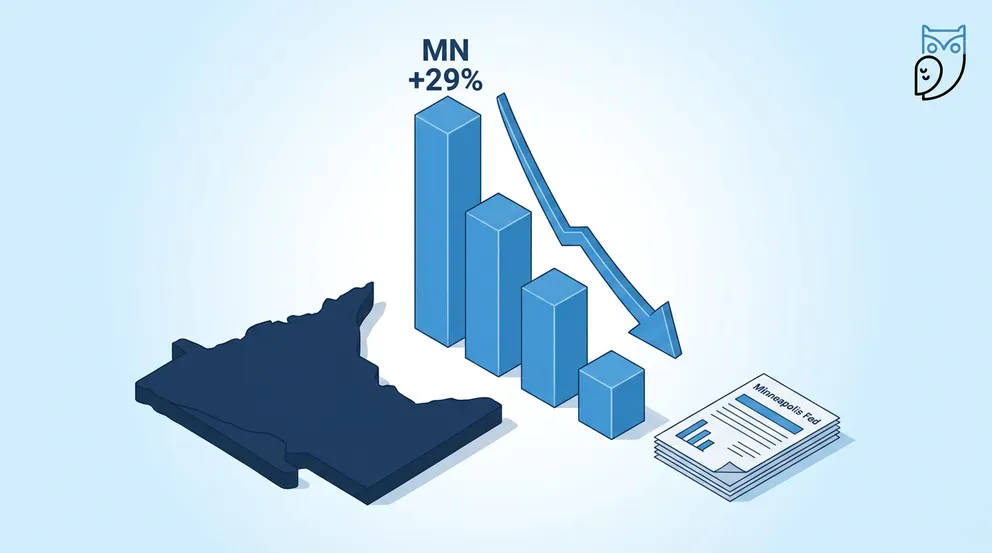
A Federal Reserve Bank of Minneapolis report published May 27, 2026 found Minnesota auto insurance premiums rose 29% between 2022 and 2024, the ninth-highest jump in the country and above the 27% national average. Minnesota quotes are now dropping 11% year over year through March 2026, nearly double the 6% national decline tracked by Insurify, though prices remain 63% higher than they were in March 2022.
The Minneapolis Fed's senior writer Tu-Uyen Tran pinned the spike on three forces: billion-dollar hail storms in the Twin Cities, repair shop labor costs that ran four times the national pace, and statistical models that left insurers scrambling to rebuild reserves after the worst underwriting year in three decades.
For Minnesota drivers paying around $1,975 a year for full coverage according to Bankrate's March 2026 data, the Fed report explains why premiums climbed so steeply and signals that the worst of the surge is behind them. Drivers who haven't shopped a renewal in 12 months are sitting on the largest year-over-year rate drop in the Ninth Federal Reserve District.
- Minnesota auto premiums surged 29% between 2022 and 2024, ranking 9th highest in the US and 2 percentage points above the 27% national average
- Insurify quotes for Minnesota drivers fell 11% year over year through March 2026, compared with a 6% national decline
- March 2026 Minnesota quotes are still 63% higher than March 2022; nationwide quotes sit 41% higher
- Billion-dollar Twin Cities hail storms in 2022 caused more than $5 billion in damage and drove comprehensive claims higher than collision or liability
- Minnesota body shop wages climbed 16% in 2021 versus 4% nationwide, per Bureau of Labor Statistics data cited in the report
What the Minneapolis Fed Report Found
Tran's analysis pulled premium data from the National Association of Insurance Commissioners and adjusted it for the number of insured vehicles in each state. That adjustment matters because raw premium totals climb whenever more cars get insured, masking the actual price change per driver.
Once the vehicle-count adjustment was applied, Minnesota landed at a 29% increase between 2022 and 2024. South Dakota, North Dakota, Wisconsin, Montana, and Michigan, the other Ninth District states, all posted smaller increases. The national average came in at 27%.
"These are all the things that stack up as far as the risks that insurers have to evaluate to get to the premium that you and I pay," Aaron Cocking, president and CEO of the Insurance Federation of Minnesota, told the Fed.
The 2023 combined average premium jump nationwide hit 14%, the largest single-year increase in nearly 40 years, according to NAIC. Minnesota's combined premium rose 15% the same year, edging the country.
Source: Minneapolis Fed analysis of NAIC and Insurify data. Insurify quotes reflect one year of coverage for drivers ages 20 to 70 with clean records and average or better credit. The 2022-2024 premium change is adjusted by the change in liability-insured vehicles, with 2024 figures projected from recent-year averages.
How Minnesota Compares to Other Ninth District States
The Fed's first chart laid out a stark contrast. Minnesota's 29% increase towered over the 9-percentage-point range posted by the other Ninth District states. Wisconsin drivers, who pay around $1,902 annually for full coverage according to the Wisconsin car insurance market, saw a much milder premium increase over the same period.
| State | 2022-2024 Premium Change | 2025-2026 YoY Quote Change | Region |
|---|---|---|---|
| Minnesota | +29% | -11% | 9th District |
| National Average | +27% | -6% | US |
| Wisconsin | Below average | Largest decline | 9th District |
| South Dakota | Below average | Declining | 9th District |
| North Dakota | Below average | Not specified | 9th District |
| Montana | Below average | Not specified | 9th District |
| Michigan | Below average | Not specified | 9th District |
Source: Federal Reserve Bank of Minneapolis (May 27, 2026), using NAIC premium data and Insurify quote data. The Ninth Federal Reserve District covers Minnesota, Wisconsin, South Dakota, North Dakota, Montana, and Michigan's Upper Peninsula.
Billion-Dollar Hail Storms Drove Comprehensive Claims
The National Weather Service counted 581 severe hail storms in Minnesota in 2022. That is nearly twice the 10-year average of 301, and the count stayed elevated at 350 in 2023.
Two of the 2022 storms hit the Twin Cities metro and surrounding areas, causing more than $5 billion in damage according to the Minnesota Department of Natural Resources. A 2023 hail storm added at least $1.5 billion in damage to the Twin Cities tally.
The geography of those storms compounded the financial hit. The Twin Cities metro houses nearly 60% of all motor vehicles registered in Minnesota. A single hail storm hitting the metro damages proportionally far more cars than a comparable storm in states where population spreads across multiple metros.
"One severe storm probably won't affect rates much because insurers expect these and price accordingly. What they don't count on is a string of severe storms," said Aaron Cocking, President and CEO of the Insurance Federation of Minnesota.
Comprehensive coverage, which pays for hail and other non-collision damage, became the single biggest driver of Minnesota's 2023 premium jump. That pattern stood out across the Ninth District. In every other state, liability coverage led the increases. Only South Dakota came close to Minnesota's comprehensive-driven surge, after a 2022 derecho caused roughly $2.8 billion in damage across multiple states including the Sioux Falls metro.
Repair Costs and Body Shop Wages Spiked Faster in Minnesota
Collision coverage tells a separate story. Crash rates have stayed relatively low since the pandemic, but repair costs climbed sharply because of pandemic-era supply chain disruptions and labor shortages. The average collision claim rose 19% nationwide in 2021 and another 18% in 2022, per NAIC data cited in the Fed report.
Minnesota outpaced both years. Repair costs in the state grew 23% in 2021 and 19% in 2022. The Fed pointed to labor as a key reason. According to the Bureau of Labor Statistics, wages for Minnesota body shop workers rose 16% year over year in 2021. Nationwide, body shop wages rose only 4% over the same period.
Drivers in Minneapolis pay roughly $141 per month for full coverage according to MoneyGeek's 2026 rate analysis, the most expensive of any major Minnesota city. St. Paul averages $139, while Duluth comes in at $98 and Rochester at $101 per month.
Insurers Suffered Worst Underwriting Year in 30 Years
The premium spike was not pure profit-taking. NAIC data showed 2022 was the worst underwriting year for auto insurers in at least three decades. The national underwriting loss averaged 12% of premium income. In Minnesota, it averaged 16%, the eighth highest among states. The industry has since recovered, with AM Best reporting auto rate hikes slowed to 3.7% in 2025 as carriers returned to profitability.
Phillip Vigliaturo, an actuary with the Minnesota Department of Commerce, told the Fed that insurers do not simply pass through past losses. They use statistical models to forecast future costs based on past events, then set rates that aim to cover those forecasted costs plus a profit margin. The catch is that anomalies typically get excluded from rate-setting, since they are assumed to be over before new rates take effect.
One academic analysis cited in the report suggested insurers initially treated the 2022 repair cost spike as a temporary anomaly. By the time models incorporated the increase as a lasting pattern, reserves were already depleted, requiring sharper catch-up rate hikes in 2023.
Why Rates Are Now Falling Faster in Minnesota
Minnesota's 11% year-over-year quote decline through March 2026 nearly doubles the 6% national drop. Two factors explain the gap.
First, Minnesota premiums spiked higher in the first place, giving insurers more room to cut as cost inputs normalize. Second, consumer shopping has accelerated. J.D. Power's 2025 insurance shopping study documented record shopping activity, pressuring carriers to compete on price.
Minnesota also has a regulatory backstop. State law requires public hearings on auto insurance rate increases exceeding 25% in any 12-month period. Regulatory filings cited by the Fed show the threat of those hearings has caused insurers to scale back proposed hikes during the surge years.
Insurify's quote data reflects what insurers offer to shoppers, which often skews toward customers with higher rates who are actively looking to switch. Actual premiums paid by existing policyholders may move differently than headline quote trends. Verify your own rate change at renewal rather than assuming the 11% statewide average applies to your policy.
What Minnesota Drivers Should Do Now
Minnesota's softening market gives drivers leverage they did not have during the 2022-2024 surge. The window matters because carriers tend to slow rate cuts once shopping activity tapers.
Pull Your Last 24 Months of Premium History
Compare your current premium against what you paid in mid-2022. If your rate climbed 29% or more, you matched the state average; if it climbed less, your carrier was relatively conservative. Both groups should shop, but customers with the steepest increases have the most to gain.
Get Quotes From At Least Three Carriers
Auto-Owners is the cheapest major insurer for Minnesota drivers according to Bankrate. Compare a regional carrier like Auto-Owners or American Family against a national name like State Farm or GEICO. Minnesota's competitive pressure means a price gap of $300 to $600 annually is common.
Ask About Comprehensive-Specific Discounts
Carriers know hail risk drove Minnesota premiums higher. Ask whether parking your vehicle in a garage, or installing impact-resistant covers, qualifies for a comprehensive coverage discount. Roof-only damage waivers and hail deductible buybacks are increasingly common product variations.
Verify Your No-Fault PIP Coverage Limits
Minnesota requires $40,000 in personal injury protection. Many drivers carry only the minimum. Check whether your current coverage matches typical medical costs in your area, and use your renewal shopping to compare PIP limits across quotes. Read our breakdown of no-fault versus at-fault state systems to understand how PIP affects claim payouts.
File Complaints if Renewals Exceed 25%
Contact the Minnesota Department of Commerce if your renewal exceeds 25% over the prior 12 months. State law triggers public hearings on rate hikes at that threshold, and complaints can prompt regulatory review of your carrier's filings.
What to Watch Next
The Fed report is balanced, noting that premiums are coming down but warning that quote levels remain well above pre-surge prices. Three signals will determine whether the current rate softening continues into late 2026 and 2027.
Watch the 2026 storm season. Minnesota's billion-dollar storms in 2022 and 2023 set the comprehensive coverage premium spike. A quiet hail season would let carriers continue cutting rates; another major storm cluster would force them to rebuild reserves again. Coastal drivers face a parallel weather-rate dynamic, as covered in our 2026 hurricane season auto insurance preparation guide.
Watch repair cost inflation. The Fed cited Minneapolis Fed analysis from 2023 showing repair costs continued rising even as broader inflation eased. NAIC's 2024 and 2025 collision claim data, expected to publish in late 2026, will reveal whether the trend has finally normalized.
Watch regulatory filings. Minnesota Department of Commerce posts rate filings publicly. Insurers can lawfully decrease rates without public hearings, but they often delay reductions when forecasts allow. Filings posted in the second half of 2026 will signal whether the 11% decline continues.
Frequently Asked Questions
The Minneapolis Fed identified three reasons. Billion-dollar hail storms hit the Twin Cities in 2022 and 2023, causing more than $6.5 billion in combined damage. Repair labor costs in Minnesota rose 16% in 2021 versus 4% nationally per Bureau of Labor Statistics data. And nearly 60% of Minnesota's registered vehicles concentrate in the Twin Cities metro, so single storms damage proportionally more cars than in states with spread-out populations.
Insurify quote data shows Minnesota auto insurance quotes fell 11% year over year through March 2026, compared with a 6% national decline. The drop is the largest in the Ninth Federal Reserve District. Actual premiums paid by existing policyholders may differ from quote trends, so verify your renewal rate against your current premium.
No. The Fed report noted that despite the recent declines, Minnesota quotes in March 2026 were still 63% higher than March 2022. Nationwide quotes sit 41% higher than 2022. Drivers should not expect a full return to pre-surge premiums; the rate cuts are correcting an overshoot, not erasing it.
Bankrate's March 2026 data puts Minnesota's average full coverage premium at $1,975 annually, or about $165 monthly. MoneyGeek tracks city-level rates: Minneapolis averages $141 per month for full coverage, St. Paul $139, Rochester $101, and Duluth $98.
Rate hikes above 25% in any 12-month period trigger public hearings under Minnesota law. The hearing requirement has caused insurers to scale back proposed rate increases. If your renewal exceeds 25% over the prior year, contact the Minnesota Department of Commerce to verify the filing and request a review.
- Federal Reserve Bank of Minneapolis - Why did auto insurance rates go up so much in Minnesota? (May 27, 2026)
- Bankrate - Average Cost of Car Insurance in Minnesota (2026)
- MoneyGeek - Average Car Insurance Cost in Minnesota (2026 Rates)
- Insurify - Minnesota Car Insurance Quotes and Rate Data
- J.D. Power - 2025 US Insurance Shopping Study
- Minnesota Department of Natural Resources - 2022 Southern Minnesota Hail Storms Damage Report
- Minnesota Department of Natural Resources - August 2023 Twin Cities Hail Storm
- Federal Reserve Bank of Minneapolis - Despite Easing Inflation, Vehicle Repair Costs Soar (2023)