

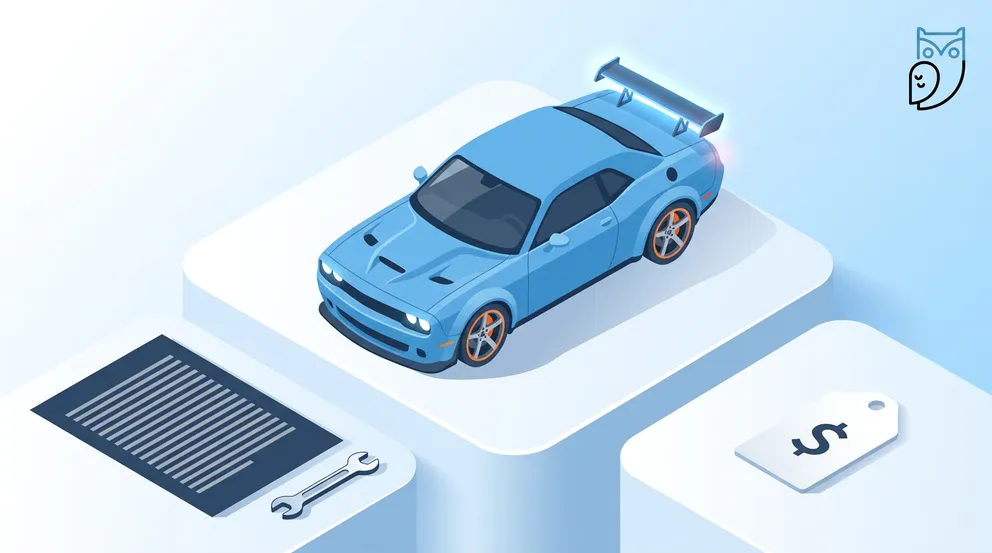
A standard ISO-based policy pays for only the first $1,500 of your aftermarket parts. To cover more, you'll need custom parts and equipment (CPE) coverage, which Progressive typically caps at $5,000, or agreed value coverage.
About one in four vehicle owners bought accessory or performance parts in 2025, SEMA's 2026 Market Report found. If you're one of them, you helped push spending to $52.92 billion, with more than $15 billion going into pickups.
You probably never called your insurer about it. Plenty of owners don't. But your policy was priced for the car that left the factory, not the one with a 3-inch lift and 35-inch tires sitting in your driveway.
- Your standard ISO-based policy pays for the first $1,500 of custom equipment and $1,000 of non-factory electronics.
- CPE lets you raise that to $2,000 to $10,000; Progressive's limit is typically $5,000.
- If your build is worth more than the car's market value, look at agreed value coverage.
- Hide a mod, lose the claim.
- CPE riders commonly exclude illegal mods, and if you're caught tampering with emissions controls, EPA civil penalties run up to $4,527 per tampering event.
Does Car Insurance Cover Modified Cars?
Partly. Your comprehensive and collision coverage will repair the car, but your aftermarket parts sit in their own category with a much smaller cap.
Many insurers adopt or adapt the Personal Auto Policy written by ISO, the Insurance Services Office, the industry's reference contract. Its 2018 edition excludes "custom equipment" outright, then gives you back the first $1,500.
So if you've put a $6,000 set of wheels and a lift on your truck, most of it's on you, according to the FC&S policy analysis PropertyCasualty360 published.
Your electronics get an even smaller cap. Audio, video or navigation gear you've permanently installed where the automaker didn't put it is limited to $1,000.
Your radar detector isn't covered at all, and neither is portable gear you haven't permanently installed.
What Counts as Custom Equipment?
ISO defines it as any equipment, furnishings or parts that didn't come from the automaker and aren't a like-kind replacement. If you've built an off-road truck, the form's examples will look like your parts receipts.
- Your lift kit, plus any body, engine, exhaust or suspension enhancer
- Custom wheels and tires on your rig (spinners count)
- A winch or anti-sway bar you bolted on
- Paintwork, chrome, murals or decals that didn't come from the factory
- Bolt-ons such as spoilers, hood scoops, side pipes and grilles
- Your bed liner, cap or tonneau cover
- Van-conversion gear like special carpeting, furniture, bars and raised roofs
Your stereo and navigation unit aren't on that list. They fall under the separate $1,000 electronics limit instead.
How Much a Standard Policy Pays for Your Mods
That $1,500 is a total for everything custom on your car, not a per-part allowance. Run your build through it and you'll see the gap grow fast.
| Value of Your Custom Equipment | Standard ISO Policy Pays | You Pay Out of Pocket | Share Covered |
|---|---|---|---|
| $1,500 | $1,500 | $0 | 100% |
| $3,000 | $1,500 | $1,500 | 50% |
| $5,000 | $1,500 | $3,500 | 30% |
| $10,000 | $1,500 | $8,500 | 15% |
| $20,000 | $1,500 | $18,500 | 7.5% |
Source: InsureMojo calculation using the 2018 ISO policy's custom equipment provision, per FC&S/PropertyCasualty360. Assumes a total loss of the equipment before your deductible, with no endorsement; your insurer's form may differ, so check your declarations page.
Indiana Farm Bureau uses the same $1,500 baseline. Its December 2025 guide prices custom rims at $2,000 to $5,000 or more and pro wraps at $3,000 or more, so a single upgrade can blow through your limit.
5 Ways to Insure a Modified Car
You've got five distinct ways to insure a modified vehicle. What separates them is how your check gets calculated after a loss, and that can swing your payout by thousands of dollars.
Custom Parts and Equipment (CPE) Coverage
Custom parts and equipment coverage is an endorsement that raises the dollar limit your policy pays for aftermarket parts. You add it on top of comprehensive and collision; Elephant states flatly that CPE "cannot be purchased alone."
Limits usually run from $2,000 to $10,000, and $5,000 is the most common, according to Yahoo Finance. Progressive says its CPE coverage typically tops out at $5,000 for things like your stereo or custom wheels.
It fits a daily driver with a few thousand dollars in bolt-ons, and you'll pay your normal deductible on a claim, the same as any comprehensive or collision loss.
Excess Custom Equipment Endorsement
The excess custom equipment endorsement (ISO form PP 03 18) is the standardized version of CPE. It lets you schedule coverage above the first $1,500 in $1,000 steps, from $2,000 up to $10,000, per the FC&S analysis.
Indiana Farm Bureau's limits mirror it: $1,500 included, raisable to $10,000. But there's a catch. You can't buy extra limit "just in case"; your parts must already be installed or bought for installation.
Agreed Value Policy
Agreed value coverage fixes your total-loss payout when you buy the policy, mods included, with no depreciation. Experian notes you'll usually need receipts plus a professional appraisal to qualify.
Why bother? Your standard policy pays actual cash value (ACV), the lesser of market value or the cost to repair with like-kind parts. And $12,000 of mods rarely adds $12,000 to what your used truck would sell for.
That gap matters more than it used to. CCC Intelligent Solutions found a record 23.1% of auto claims ended in a total loss in 2025. Our agreed value insurance guide walks you through the mechanics.
Stated Value Policy
A stated value policy, also called stated amount, sounds like agreed value but works against you. Progressive defines it as paying the actual cash value or the amount you say the car is worth, "whichever is less."
So you could pay premiums on a $40,000 figure and still collect $28,000 if that's the market value. You've set a ceiling, not a guarantee. Ask which one you're buying before you sign.
Collector and Specialty Car Policies
Own a hot rod, resto mod, custom import, replica or pro-street build? Specialty carriers like Hagerty will write you a collector car policy. After a covered total loss, you get Hagerty's Guaranteed Value, its version of agreed value.
Big horsepower isn't an automatic no. In May 2026, Hagerty told agents that cars with 650-plus horsepower "may still qualify," though you'll face extra underwriting on your driving history and the vehicle's value.
The trade-off is how you use the car. Insurify notes Hagerty doesn't insure regular-use vehicles and sets storage and driver requirements. In exchange, you could pay up to 42% less than on a standard policy, Experian says, citing Nationwide.
If you're weighing specialty carriers, our classic car insurance guide compares them side by side.
Got a project car you haven't finished? Hagerty's Vehicle Under Construction coverage raises your Guaranteed Value 10% per quarter, up to a $25,000 increase, and includes $750 for your tools.
| Option | How the Payout Works | Custom Parts Limit | vs. $1,500 Standard Cap | Best For |
|---|---|---|---|---|
| Standard policy, no add-on | Car's ACV plus the first $1,500 of custom equipment | $1,500 ($1,000 for electronics) | Baseline | Mods under $1,500 |
| CPE coverage | Repairs or replaces aftermarket parts up to the limit, minus deductible | $2,000 to $10,000 ($5,000 typical) | 1.3x to 6.7x | Daily drivers with bolt-ons |
| Excess custom equipment (PP 03 18) | Scheduled amount above the first $1,500 | Up to $10,000, in $1,000 steps | Up to 6.7x | Carriers using ISO forms |
| Stated value | Lesser of ACV or your stated amount | Your stated figure, as a ceiling | Varies | Rarely the best pick |
| Agreed value or collector policy | Fixed amount set at purchase, no depreciation | The car's whole agreed value | No separate cap | Show cars and high-dollar builds |
Source: ISO Personal Auto Policy and PP 03 18 endorsement (FC&S/PropertyCasualty360), Yahoo Finance (August 2025), Progressive and Experian (February 2026). Multiples compare each limit with the $1,500 custom equipment cap in the standard ISO form.
Custom Parts Coverage Limits by Insurer
Only a handful of carriers publish their numbers, which leaves you guessing. We pulled what each one states on its own site, then filled the gaps with named third-party reviews.
| Insurer | Included Automatically | Highest Published Limit | vs. ISO $1,500 Baseline |
|---|---|---|---|
| ISO standard form (2018) | $1,500 custom; $1,000 electronics | $10,000 with PP 03 18 | Baseline |
| Indiana Farm Bureau | $1,500 | $10,000 | 6.7x at max |
| Progressive | $1,000 with comp and collision, per Insurance.com | Typically $5,000 | 3.3x |
| Elephant | "A limited amount" with comp and collision ($1,000, per MoneyGeek) | Up to $20,000, per Insurify | 13.3x |
| Allstate | Not published | Not published; add-on about $102/yr, per MoneyGeek | n/a |
| Farmers | Not published | Add-on for full-coverage policies, limit not published, per Insurify | n/a |
| Hagerty | Guaranteed Value covers the whole car | Agreed value; Vehicle Under Construction adds up to $25,000 | No separate cap |
Source: carrier websites (Progressive, Elephant, Indiana Farm Bureau, Hagerty) reviewed November 2026; Insurance.com (February 2026), MoneyGeek (July 2026) and Insurify (November 2026) where the carrier doesn't publish a figure. Limits vary by state and policy form.
GEICO and State Farm don't list CPE limits online. Call your agent and ask for the custom equipment figure on your declarations page, in dollars. If none appears, ask whether your form uses a $1,500 or $1,000 default.
If you're shopping carriers, our Progressive review and Farmers review walk you through their other add-ons and pricing.
How Much Does Modified Car Insurance Cost?
The add-on itself is often cheap. MoneyGeek puts Allstate's optional custom parts coverage at about $102 a year, so you'd pay roughly $8.50 a month.
Bigger builds cost you more. Insurance Panda estimates the added premium at about 10% of your mods' value per year, Yahoo Finance reports. On $6,000 of parts, you'd pay around $600 a year, or $50 a month.
Honestly, at $102 a year it's an easy yes. At $600, you'd pay for 7.5 years before premiums match the $4,500 you'd lose in one theft, so weigh how often your truck sits outside overnight.
Mods That Raise Your Rate and Mods That Can Lower It
Your base premium can move too, separate from the add-on. Progressive notes some insurers won't write your car at all if "the engine's performance is seriously enhanced."
- Alarms and GPS trackers that make your car harder to steal
- Front and rear cameras, or parking sensors you've added
- Adaptive headlights, which Progressive says can earn you a discount
- A turbocharger or an engine tune
- A lift or a lowered suspension changes how your car handles
- Custom paint or wheels push up your car's value
- Your $5,000 sound system makes the car a bigger theft target
Safety gear isn't always a win, though. Progressive warns that added safety systems "may actually cause your rates to go up" when they're pricey to repair. You can check which devices qualify in our anti-theft discount guide.
What Happens If You Don't Tell Your Insurer?
Best case, your insurer pays for factory-equivalent parts and you eat the rest. Progressive says undisclosed custom elements "may not be covered," and the repairs become your financial responsibility.
The worst case is uglier. Experian warns that hiding modifications "could be considered fraud" and may get your policy canceled or your claim denied. That puts your whole claim on the line, not just the turbo.
Picture this. You add $4,000 in wheels and a lift to your pickup and never call.
Then the truck gets stolen. The adjuster spots the build in your old listing photos, and now you're on the hook for a material misrepresentation question instead of collecting a $4,000 payout.
So call your insurer within days of the install, not at renewal. Our guide to car insurance disclosures covers every change you're expected to report.
Keep every receipt. Your CPE claim pays on documented value, and Hagerty tells its agents to collect build receipts and a modification list before quoting a modified vehicle. Without paper, you're negotiating from memory.
Modifications Insurers Won't Cover
- Anything illegal, starting with parts that disable your emissions controls
- Homemade modifications you fabricated yourself
- Certain suspension changes and snowplow gear, both on Yahoo Finance's list of common CPE exclusions
- Your track days, since the ISO form excludes damage inside a racing facility during an organized race or driver skill event
- A radar or laser detector, under its own ISO exclusion
- Whatever exceeds your limit
Track days deserve a flag. Because the exclusion reaches driver skill training, you could take a $60,000 car to a high-performance driving event with no physical damage coverage for the day. Ask about track-day coverage before you register.
The full list of auto policy exclusions goes beyond mods, and it's worth five minutes of your time.
Emissions Tampering and EPA Penalties
If you delete or defeat your emissions system, federal law still applies. EPA lists civil penalties of up to $4,527 per tampering event or defeat device sale, and $45,268 per noncompliant vehicle.
Enforcement has shifted, not vanished. The Justice Department said in January 2026 it would stop criminally prosecuting diesel-delete cases, FleetMaintenance.com reported, but you can still face civil enforcement.
Sellers get hit hardest. Meyer Distributing agreed in January 2025 to pay a $7.4 million civil penalty after selling more than 90,000 defeat devices, according to EPA.
California's CARB Executive Order Rule
California goes further than federal law. Vehicle Code 27156 bars selling or installing emissions-related aftermarket parts unless the California Air Resources Board has exempted them with an Executive Order (EO) number.
A part without one can fail your Smog Check and cost you your registration, plus fines, according to CARB. Check for the EO number before you buy. Our California car insurance page covers your state's other rules.
Other states regulate lift height and exhaust noise in their own equipment codes, so look yours up with your DMV before a big install.
Buying a Car That's Already Modified
You inherit the last owner's build, and your insurer won't know about it unless you say so. Ask the seller for every receipt, and pay for a pre-purchase inspection.
Hagerty's checklist for quoting a modified vehicle works as a template for any carrier you call: updated photos, build receipts, a modification list and an appraisal when applicable. Bring that file to every quote you get.
And watch the price. If you pay $35,000 for a built Ford Bronco that books at $27,000, your standard policy's ACV settlement will lean toward the lower number. That's the case for agreed value.
Inventory Every Mod
List each part with its price and install date, then photograph it on your car so an adjuster can see exactly what was there.
Find Your Current Limit
Check your declarations page for a custom equipment line. Call your insurer if it isn't there.
Price CPE Against Agreed Value
If you've got under $10,000 in parts, CPE usually fits; above that, or above your car's market value, get agreed value quotes.
Get an Appraisal for Big Builds
Specialty insurers often want one before they'll set your car's value.
Update After Every Install
Call when you install the part, not after a claim. Indiana Farm Bureau won't sell you extra limit before the part exists.
Frequently Asked Questions
Only up to a small limit. The 2018 ISO Personal Auto Policy covers the first $1,500 of your custom equipment and $1,000 of non-factory electronics. Above that, you'll need custom parts and equipment coverage or agreed value coverage.
MoneyGeek reports Allstate's custom parts add-on at about $102 a year. For larger builds, Insurance Panda estimates the added premium at roughly 10% of your mods' value per year, so $6,000 of parts would add about $600.
Yes. Your undisclosed parts may not be covered, according to Progressive, and Experian warns that concealing modifications can be treated as fraud, leading to a denied claim or canceled policy. Report each mod soon after you install it.
It can. A lift kit counts as custom equipment under the ISO policy form, so it's covered only within the shared $1,500 limit unless you add an endorsement. Some insurers also charge you more for suspension changes that affect handling.
It depends on your build. If you drive it daily with a few thousand dollars in parts, a CPE endorsement such as Progressive's (typically $5,000) works. For show or high-value builds, Hagerty's agreed value approach pays a fixed amount.
Modifying your car doesn't void your policy by itself, but hiding the mods can. Insurers may deny your claim or cancel your policy for material misrepresentation, and illegal mods such as emissions defeat devices aren't covered.
- SEMA - 2026 SEMA Market Report Reveals Nearly $53 Billion Aftermarket
- PropertyCasualty360 (FC&S) - Personal Auto Policy Contract Analysis, Part 5: Coverage for Damage to Your Auto
- Indiana Farm Bureau Insurance - Does Insurance Cover Custom Equipment on My Vehicle?
- Progressive - Car Insurance Coverages
- Progressive - Does Insurance Cover Modified Cars?
- Elephant Insurance - Custom Parts and Equipment Coverage
- Hagerty - Modified Vehicles
- Hagerty Agent - How to Quote Modified Vehicles with Confidence
- U.S. EPA - Clean Air Act Vehicle and Engine Enforcement Case Resolutions
- U.S. EPA - Meyer Distributing Clean Air Act Settlement Summary
- FleetMaintenance.com - DOJ Won't Pursue Jail Time for Diesel Deleting; Civil Penalty Risk to Remain
- California Air Resources Board - Aftermarket, Performance, and Add-on Parts
- Experian - What Is Modified Car Insurance?
- MoneyGeek - Modified Car Insurance (2026 Guide)
- Yahoo Finance - Custom Parts and Equipment Insurance: What It Covers
- Insurify - Car Insurance for Modified Cars (2026)
- Insurance.com - Modified Car Insurance: How Do You Insure a Modified Vehicle?