

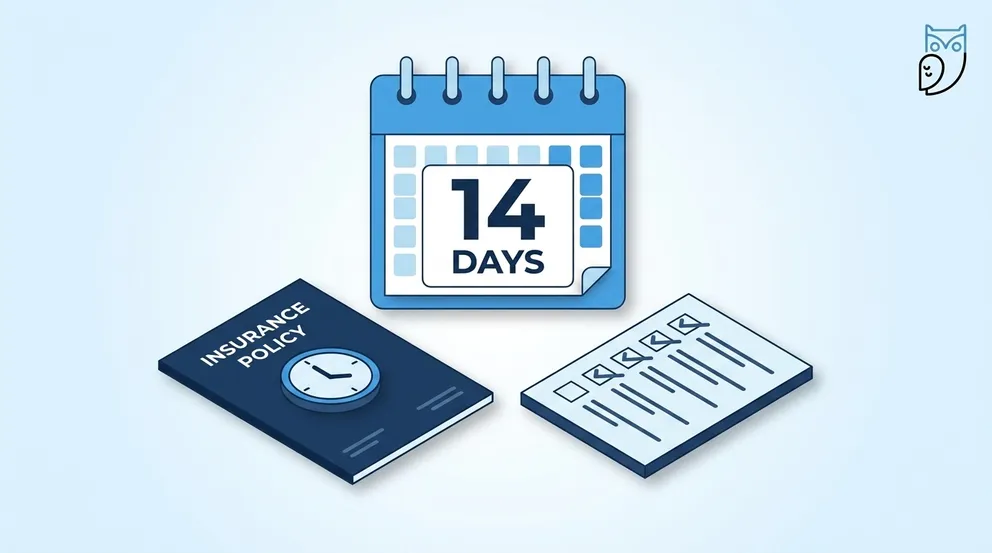
Most insurers give you 14 to 30 days to add a newly purchased car to an existing policy. The standard personal auto contract used across the industry sets 14 days to request collision and comprehensive coverage, dropping to 4 days if no car on your policy already carries those coverages. GEICO and Progressive allow 30 days; State Farm allows 14.
The phrase "grace period" makes it sound like a legal right. It isn't. No state statute grants you a window to insure a car you just bought, and the protection you're relying on when you drive off the lot comes from a specific paragraph in your policy contract called the newly acquired auto clause.
That paragraph is worth understanding, because it draws a line between two situations most drivers treat as identical: replacing a car versus adding one. Get that distinction wrong and you can lose collision coverage on a $42,000 vehicle 15 days after you sign the paperwork.
- No state mandates a new car grace period; the window comes from your policy contract, not from law
- The industry-standard clause allows 14 days to request comprehensive and collision on a newly acquired auto
- Carrying zero physical damage coverage on your current cars shrinks that window to 4 days and triggers a $500 deductible
- Liability follows a replacement vehicle with no notification deadline; an additional vehicle requires a request within 14 days
- Request coverage late and it starts the day you call, with no retroactive protection for a loss that already happened
- Drivers without any active policy get no grace period at all
What the Grace Period Actually Is
Your policy covers vehicles listed on the declarations page. A car you bought yesterday isn't on that page yet, so insurers built a bridge provision into the contract that temporarily extends coverage to vehicles you've just acquired.
Insurance Services Office, the organization that drafts the standard forms roughly 80% of US personal auto carriers build their policies from, defines a "newly acquired auto" as any private passenger vehicle, or a pickup or van rated at 10,000 pounds GVWR or less, that you become the owner of during the policy period. Carriers file their own versions, and some extend the deadlines, but the ISO language is the floor almost everyone starts from.
CarInsurance.com states plainly that grace periods "aren't guaranteed by law in most states." Nevada is the strictest example, where drivers are expected to have active coverage in force before operating the vehicle at all. Confirm your carrier's window before you shop, not after.
The 14-Day and 4-Day Rules in Your Policy
Most guides report a range of 7 to 30 days and leave it there. The contract actually splits coverage into three separate buckets, each carrying its own deadline.
Liability, uninsured motorist, and medical payments coverage begin the date you become the owner, and the new car receives the broadest version of that coverage carried on any vehicle in your declarations. Collision and other-than-collision (the contract term for comprehensive coverage) also begin on the ownership date, but only if you ask within a set number of days.
| Coverage | When it starts | Deadline to request | Penalty for a late request |
|---|---|---|---|
| Liability, UM, MedPay (replacement car) | Date you become owner | No stated deadline | None |
| Liability, UM, MedPay (additional car) | Date you become owner | 14 days | Coverage starts when you call |
| Collision, if a listed car has it | Date you become owner | 14 days | Coverage starts when you call |
| Collision, if no listed car has it | Date you become owner | 4 days | $500 deductible applies |
| Comprehensive, if a listed car has it | Date you become owner | 14 days | Coverage starts when you call |
| Comprehensive, if no listed car has it | Date you become owner | 4 days | $500 deductible applies |
Source: ISO standard Personal Auto Policy form, Definitions section K (Newly Acquired Auto), as filed in state-approved carrier policy forms. Individual carriers may file more generous terms; none of the major national carriers file shorter ones.
Read that fourth row again. A driver carrying liability-only on a 2009 Corolla who buys a used Honda Accord gets exactly 4 days of collision protection, and any crash occurring before the phone call carries a $500 deductible whether or not that's the deductible they would have chosen. Liability-only households make up a meaningful share of the market, so this trap catches real people.
The contract says that if you request coverage after the window closes, protection "will begin at the time you request the coverage." Nothing is retroactive. Total your uninsured new car on day 16 and calling on day 17 does not create a claim.
Grace Period by Insurance Company
Several national carriers file windows longer than the 14-day ISO baseline. Verify yours against your own declarations page, because the same brand can file different terms in different states.
| Insurer | Reported window | vs. 14-day standard | What to know |
|---|---|---|---|
| GEICO | 30 days | +16 days | Longest common window; coverage mirrors your existing policy |
| Progressive | 30 days | +16 days | Applies to both replacement and additional vehicles |
| Nationwide | Up to 30 days | +16 days | Agent confirmation recommended before purchase |
| Allstate | 7 to 30 days | -7 to +16 days | Varies by state and policy type |
| Liberty Mutual | 5 to 30 days | -9 to +16 days | Wide spread; check your specific form |
| State Farm | 14 days | Matches standard | Half of what GEICO and Progressive allow |
| Regional carriers | 7 to 10 days | -7 to -4 days | Shorter windows are common with smaller insurers |
Windows reported by WalletHub carrier research and Penny Pincher's August 2026 grace period analysis. Terms are set by the policy form filed in your state and can change at renewal.
Switching from a regional carrier with a 7-day window to GEICO's 30 days buys you 23 extra days of margin, which matters if you close a deal on a Saturday afternoon before a holiday weekend.
Replacing a Car vs. Adding a Car
This distinction decides whether a deadline applies to your liability coverage at all, and almost no consumer guide explains it correctly.
- Liability, UM, and MedPay transfer from the traded car with no notification deadline in the standard form
- Physical damage coverage carries over, but only if you request it within 14 days
- Your old car leaves the policy the day you sign the trade paperwork
- Premium change is usually modest unless the new vehicle costs far more to repair
- 14-day deadline attaches to every coverage, liability included
- Broadest coverage on any listed car applies during the window
- Missing the 14 days leaves the added car with no coverage until you call
- A multi-car discount of 8% to 35% typically offsets part of the added premium
MoneyGeek puts the average annual cost of a second vehicle at roughly $1,185, while Nationwide's multi-car discount averages 34% and Farmers reaches 48% at the top end. A two-vehicle household saves about $830 a year from the discount alone, which softens the sticker shock of the endorsement.
What Happens if You Crash During the Window
Within the window, and assuming you meet the notification requirement, your insurer processes the claim under your existing policy's limits and deductibles. Someone carrying 100/300/100 liability with a $500 collision deductible on a listed sedan gets those exact terms on the new car.
Two things surprise people. Your deductible is whatever the listed vehicles carry, so a household running a $1,000 deductible to keep premiums down pays $1,000 out of pocket on a car it has owned for five days. And limits do not scale to the new vehicle's value, meaning a driver with state minimum liability who upgrades to a $60,000 truck still carries minimum limits until the policy is formally updated. Reviewing how much coverage you actually need at purchase time costs nothing and prevents that mismatch.
The grace period protects the car. It does nothing to upgrade limits that were already too low for the vehicle you just financed.
No Existing Policy Means No Grace Period
Every provision described above extends coverage from a policy that already exists. First-time buyers, drivers returning after a lapse, and anyone who cancelled after selling their last car receive nothing, because there is no declarations page for coverage to extend from.
Nearly every state requires liability coverage to operate a vehicle, and a lapse on your record raises future premiums by 10% to 20% at your next quote. Buying a policy the morning of your dealership appointment takes about 15 minutes online and eliminates the problem entirely.
What the Dealership and Lender Require
Proof of insurance is a condition of taking delivery at essentially every franchised dealership, new or used, purchase or lease. Three documents typically satisfy the finance office: a current insurance ID card in physical or digital form, your policy declarations page, or an insurance binder sent directly from your carrier.
Digital ID cards are now accepted in 49 states plus the District of Columbia, with New Mexico the lone holdout where officers aren't required to accept them. Storing your card in Apple Wallet before you go removes one point of friction from a process that already takes three hours.
Call your carrier from the dealership parking lot with the VIN before you sign. Most insurers issue a binder by email in under 10 minutes, which satisfies the finance office and starts your coverage on the correct date instead of relying on a window you'd rather not test.
Financing changes the math. Lenders require comprehensive and collision, not just liability, and they verify it before funding. Skipping straight to full coverage at purchase avoids a force-placed policy, which lenders buy on your behalf at two to three times market rate when they can't confirm coverage. Since a new vehicle can depreciate 20% in year one, gap insurance is worth pricing at the same time if you financed more than the car is worth.
State Rules Raise the Stakes in 2026
No state mandates a new car grace period, but several have raised the minimum liability limits you'd be judged against if you cause a crash while underinsured.
| State | New minimum limits | Effective | Change |
|---|---|---|---|
| California | 30/60/15 | Jan 1, 2025 | First increase since 1967 |
| Utah | 30/65/25 | Jan 1, 2025 | Raised from 25/65/15 |
| Virginia | 50/100/25 | Jan 1, 2025 | Second step of a phased increase |
| North Carolina | 50/100/50 | July 1, 2025 | Raised from 30/60/25 |
| New Jersey | 35/70/25 | Jan 1, 2026 | Raised from 25/50/25 |
Buying a car in North Carolina now means the state expects 50/100/50 behind it, and rising floors are one reason minimum-coverage premiums climbed 14% while full coverage fell. Registration rules add their own wrinkles: New York requires an in-state licensed insurer that files coverage electronically with the DMV, New Jersey requires its official state ID card format, and Florida requires proof of both PIP and property damage liability.
What to Do the Day You Buy
Check your window before you shop
Pull your declarations page and confirm whether you have 14 days or 30, and whether any listed vehicle carries collision. Liability-only households have 4 days, not 14.
Text the VIN to your agent from the lot
The VIN, year, make, model, and odometer reading are all your carrier needs. Doing this before you sign gets the binder into the finance office without a second trip.
Match limits to the new vehicle's value
State minimums of 30/60/15 leave a driver of a $55,000 truck personally exposed. Moving to 100/300/100 typically adds $15 to $30 a month.
Add comprehensive and collision if you financed
Your lender requires it and will force-place coverage at two to three times market rate if you don't. Price gap coverage in the same call.
Confirm the change in writing
Request an updated declarations page showing the new VIN. Buying a vehicle is one of the life events that should trigger a policy review, and written confirmation settles any later dispute about your call date.
Honestly, the whole grace period question dissolves if you make one phone call from the dealership. Everything above matters only for drivers who don't, and the contract is far less forgiving than the phrase "grace period" suggests. Keeping your carrier informed about what you drive is also a basic policy obligation, and failing to disclose a vehicle creates problems well beyond a single claim.
Frequently Asked Questions
Most insurers allow 14 to 30 days. GEICO, Progressive, and Nationwide allow up to 30 days, while State Farm allows 14 and some regional carriers allow only 7 to 10. The industry-standard policy form sets 14 days to request comprehensive and collision coverage on a newly acquired vehicle, dropping to 4 days if no vehicle on your policy already carries those coverages.
No. No state statute mandates a grace period for newly purchased vehicles. The window comes from the newly acquired auto clause in your policy contract, which is written by your insurer and filed with your state regulator. Nevada is the strictest common example, where drivers are expected to have coverage in force before operating the vehicle.
Yes, if you are inside your window and meet the notification requirement. Your insurer applies your existing policy limits and deductibles to the new vehicle, so a household with a $1,000 deductible and state minimum liability gets those exact terms. If no vehicle on your policy carried collision and you notified within 4 days, a $500 deductible applies to a loss that happened before you called.
Coverage begins at the moment you request it, with no retroactive protection. A loss that occurred before your call is not covered. You may also face fines for driving uninsured, and a coverage lapse on your record typically raises premiums 10% to 20% at your next quote.
No. The grace period extends coverage from an active policy, so drivers with no current policy get nothing. First-time buyers and anyone returning after a lapse must purchase a policy before driving the vehicle. Buying coverage online typically takes about 15 minutes.
Yes, and the difference is significant. Under the standard policy form, liability, uninsured motorist, and medical payments coverage follow a replacement vehicle with no stated notification deadline. An additional vehicle requires you to request coverage within 14 days for those same protections. Comprehensive and collision carry a 14-day deadline in both cases.
- Personal Auto Policy Form (ISO copyrighted language) - Newly Acquired Auto Definition
- CarInsurance.com - New Car Insurance Grace Period Explained
- Ohio Insurance Agents - Understanding ISO's Changes to the Personal Auto Policy
- PropertyCasualty360 - Personal Auto Policy Contract Analysis: Definitions
- WalletHub - Carrier New Car Grace Periods
- MoneyGeek - Insuring Two or More Cars
- Insurance Information Institute - What Is Covered by an Auto Policy