
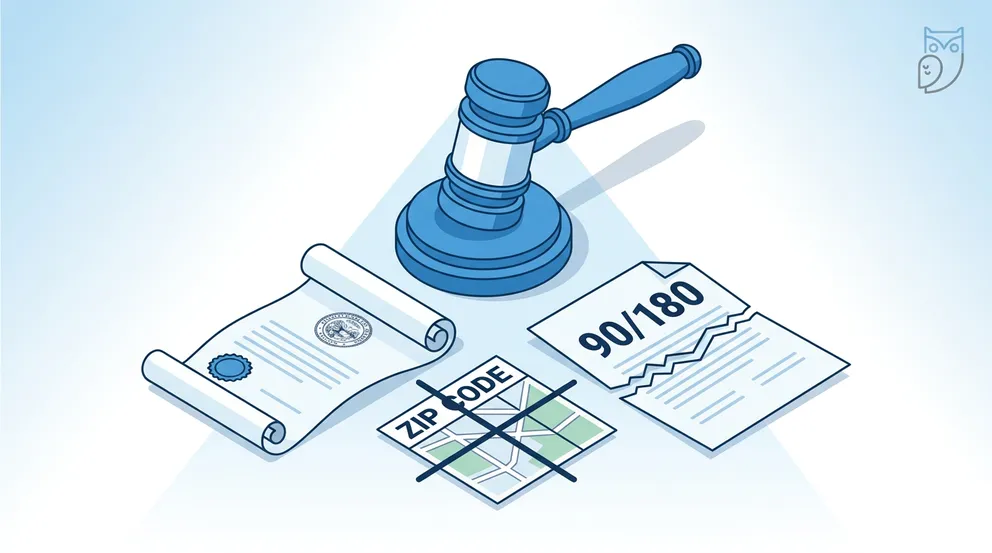
New York's final FY27 budget, passed by the Assembly on May 26-27, 2026, enacts the largest auto insurance overhaul in decades. The package repeals the 90/180 serious injury rule, caps non-economic damages at $100,000 for at-fault uninsured and intoxicated drivers, creates an excess profits refund law, bans ZIP code and education as primary rating factors, and forces 30-day disclosure for any rate hike of 10% or more.
The New York State Assembly passed the final piece of the FY27 budget early Tuesday, May 26, 2026, enacting an auto insurance reform package that industry advocates call the most significant in decades. The bill (A10008C/S8008C) cleared both chambers nearly two months past the April 1 deadline.
For 14 million licensed drivers paying an average $4,000-plus per year on coverage, the enacted provisions target three cost drivers at once: lawsuit-driven payouts, opaque rate hikes, and pricing factors that regulators say have little to do with driving risk.
- Budget enacted May 26-27, 2026, codified as A10008C/S8008C with six insurance-related parts
- TED Part EE repeals the 90/180-day serious injury rule and caps non-economic damages at $100,000 for at-fault uninsured or intoxicated drivers
- TED Part KK forces refunds when three-year underwriting gains exceed expected profit by more than 5% of earned premiums
- PPG Part JJ bans occupation, education, homeownership status, and ZIP code as primary rating factors
- Hochul projects savings of at least $200 per vehicle per year; industry groups estimate 15-20% premium reductions over time
What the Final Budget Actually Enacts
The May 11 deal announcement left several provisions unsettled. Final passage on May 26-27 resolved them. The homeowners loss ratio benchmark was dropped from the agreement, while the auto provisions Hochul proposed in January were strengthened. Six budget parts now form the enacted reform package.
TED Part EE rewrites New York's serious injury threshold by eliminating the 90/180-day standard that allowed pain-and-suffering claims based on limited daily activities during the first six months after a crash. Plaintiffs found more than 50% at fault can no longer collect non-economic damages, though they still receive no-fault benefits. The bill also caps non-economic damages at $100,000 when the at-fault driver was uninsured, intoxicated, or committing a felony.
Three rate-related parts target carrier pricing behavior. PPG Part II prohibits flex rating for personal auto increases, forcing the standard prior-approval process. PPG Part JJ bans occupation, education, homeownership, and ZIP code as the primary basis for setting rates or assigning tiers, joining a broader trend that includes credit score bans in four other states. TED Part BB requires insurers to provide written explanations for any premium increase of 10% or more, with carriers required to respond to written requests within 20 days.
TED Part KK creates the auto excess profits law. Insurers whose three-year underwriting gains exceed expected profit levels by more than 5% of earned premiums must refund the difference to policyholders as credits. PPG Part F expands the legal definition of staged motor vehicle accidents and holds anyone who hires or orchestrates a fake crash accountable for the entire loss.
How Much Money Could This Save You
Governor Hochul's office projects savings of at least $200 per vehicle per year. Industry advocates estimate the package could cut premiums by 15% to 20% once carrier rate filings work through the Department of Financial Services.
On New York's $4,000-plus average annual premium, a 15% reduction equals roughly $600 in annual savings, or about $50 per month. The $200 floor projected by Hochul represents about a 5% reduction. Drivers in New York City, where full-coverage premiums often top $5,500 per year, would see proportionally larger reductions if the ZIP code ban delivers as intended.
| NY Premium Tier | Average Annual Cost | Savings at 5% (Hochul Floor) | Savings at 15% (Advocate Estimate) |
|---|---|---|---|
| State Average (Full Coverage) | $4,000 | $200 | $600 |
| NYC Boroughs (Full Coverage) | $5,500 | $275 | $825 |
| State Minimum Coverage | $1,776 | $89 | $266 |
Source: Hochul administration projection (May 2026), Bankrate New York rate data (April 2026), and Big I New York industry savings estimate. Premiums reflect averages for drivers ages 35-55 with clean records and average credit.
Fraud and Litigation: The Cost Drivers Being Targeted
Carriers reported 43,811 incidents of suspected motor vehicle fraud to the New York Department of Financial Services in 2025, an 80% jump from five years earlier. State officials estimate that staged crashes alone add roughly $300 per year to every New York driver's premium.
"New York State is turning a corner. The newly enacted state budget tackles auto insurance fraud and excessive litigation through the most significant reforms to the state's auto insurance laws in decades. With these changes, we anticipate that New Yorkers will finally begin to see relief from some of the highest auto insurance costs in the nation." David H. Borg, Chair of the Board, Big I New York
PPG Part JJ does not eliminate geographic rating entirely. Carriers may still consider where you garage your car, claims frequency by territory, and approved actuarial factors. The change limits how much ZIP code can drive your tier assignment. Background on the framework appears in our coverage of the original budget deal announcement.
When Will New York Drivers Actually See Lower Bills
The reforms are now law, but premium reductions will lag. Carriers must refile rates with the Department of Financial Services using the new restrictions and updated litigation cost assumptions. The DFS prior-approval process typically takes 60 to 120 days per filing.
Realistic timeline: most drivers will see initial decreases on renewals issued between Q4 2026 and Q2 2027. Larger reductions tied to the litigation reforms and the excess profits law will accumulate over 24 to 36 months as claims data builds and the three-year profit benchmark trigger activates. Carriers including GEICO, State Farm, Progressive, and Allstate together write more than 60% of the New York personal auto market. Compare pricing using our State Farm review and GEICO review.
What New York Drivers Should Do Now
Check Your Renewal Date
Log into your insurer's portal to confirm when your next renewal hits. Renewals before Q4 2026 may not yet reflect the budget reforms. Ask your agent whether your carrier has filed updated rates with DFS.
Demand the 10% Rate Hike Explanation
Under TED Part BB, any premium increase of 10% or more triggers a 30-day notice with a written explanation. Call your carrier and ask which rating factors are driving your premium. You have 20 days to demand a written response.
Get Quotes from Three Carriers
Different carriers will refile at different speeds. Some pass savings through faster. Compare three quotes including a national carrier, a direct writer, and a regional player to identify which one prices the reforms into renewals first.
Review Your Rating Factors
Pull your current declarations page. Identify any tier tied to ZIP code, education, occupation, or homeownership. Once carriers refile under PPG Part JJ, those factors must drop from your tier assignment.
Watch for Excess Profits Refunds
TED Part KK requires refunds when carriers' underwriting gains exceed 5% of earned premiums over three years. Refunds arrive as policy credits, not separate checks, with the first measurement window starting on policies in force after the budget's effective date.
Where New York Stands Nationally
New York joins 28 other states with modified comparative fault rules barring non-economic damages for plaintiffs more than 50% at fault. The state's $4,000-plus average premium ranks among the three most expensive in the country, alongside Maryland ($4,224) and Louisiana ($3,950), based on 2026 Bankrate data. Michigan's 2019 no-fault reform offers the closest comparable case, cutting average premiums 18% over four years.
Neighboring New Jersey averages $2,892 per year for full coverage, while Connecticut sits at $3,180. New York's roughly $1,500 gap above the national average reflects the combined cost of fraud, litigation, and the high-density urban driving environment around New York City. Drivers comparing regional rates can review our New Jersey car insurance page for cross-border context.
What to Watch Next
The Department of Financial Services is expected to release implementation guidance within 60 days. Carrier rate filings should begin in July 2026. The first excess profits refund credits will not appear until 2029 at earliest, since the three-year measurement period requires data through the 2026-2028 policy years. Trial lawyer groups have signaled they may challenge portions of TED Part EE in court, though the rating-factor bans under PPG Part JJ are not expected to face legal challenge.
Frequently Asked Questions
The bill (A10008C/S8008C) was enacted by the Assembly on May 26-27, 2026, as part of the FY27 state budget. Provisions take effect on the budget's enacted date, but premium changes require carriers to refile rates with the Department of Financial Services. The DFS prior-approval process typically takes 60 to 120 days, so most drivers will see reform-related changes on renewals issued between Q4 2026 and Q2 2027.
Governor Hochul's office projects savings of at least $200 per vehicle per year. Industry advocates estimate the package could cut premiums by 15% to 20% over time. On New York's $4,000-plus average annual premium, that range translates to roughly $200 to $800 per year, with larger savings expected in New York City where premiums often exceed $5,500.
No. PPG Part JJ bans ZIP code as the primary basis for setting rates or assigning tiers. Insurers can still consider where you garage your vehicle, claims frequency by territory, and approved actuarial factors. The change limits how much ZIP code can drive your premium, but it does not eliminate geographic rating entirely.
TED Part KK requires auto insurers in New York to refund excess profits to policyholders as credits when underwriting gains over a three-year period exceed expected profit levels by more than 5% of earned premiums. The first measurement window starts with policies in force after the budget's effective date, so the earliest refund credits will appear in 2029. Refunds are issued as policy credits, not separate checks.
Yes, but the threshold has changed. TED Part EE repeals the 90/180-day rule that allowed claims based on limitations to daily activities during the first six months after a crash. You can still pursue non-economic damages if you meet the remaining serious injury categories, but only if you are 50% or less at fault. The cap is $100,000 for non-economic damages if the at-fault driver was uninsured, intoxicated, or committing a felony.
- Big I New York - Auto Insurance Fraud and Litigation Reforms Included in Final State Budget (May 27, 2026)
- New York State Senate - A10008C Bill Text and Amendments
- Office of Governor Kathy Hochul - Auto Insurance Reform Proposals
- New York Department of Financial Services - Auto Insurance Rate Press Release
- Insurance Journal - New York State Has Budget Deal That Includes Auto Insurance Reforms
- Bankrate - Average Cost of Car Insurance in New York for 2026
- State Farm Newsroom - New Yorkers Deserve a Path to Lower Auto Insurance Premiums