
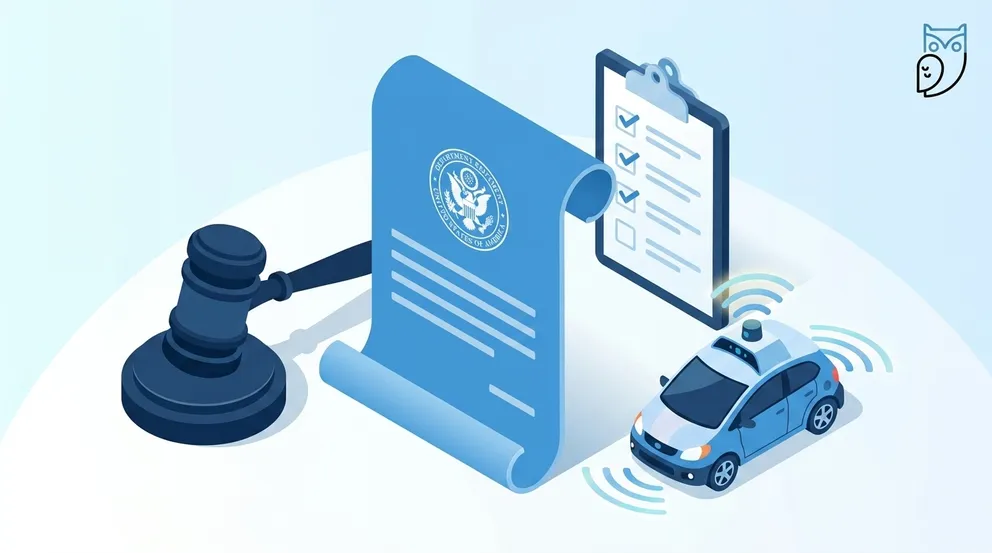
The National Highway Traffic Safety Administration is writing the first federal rules governing how self-driving cars must behave on public roads, and Administrator Jonathan Morrison said on July 17 the agency wants them finalized before the end of President Donald Trump's current term. The rulemaking follows Waymo recalls covering thousands of robotaxis and a documented pattern of driverless vehicles blocking ambulances and passing stopped school buses.
For drivers, the question that matters is not whether a robotaxi passes a federal test. It is who pays when one hits your car, and that answer swings by nearly $5 million depending on which state you are standing in.
NHTSA is drafting objective "behavioral competency" tests for autonomous vehicles under regulatory docket RIN 2127-AM99, which sits in the pre-rule stage as of July 2026. The standards would replace design rules written for human drivers, including mirrors and manual brake pedals. Nothing in the rulemaking changes your policy today: a claim against a robotaxi still runs through the operator's liability coverage, which ranges from a $5 million floor in California down to ordinary state-minimum limits in Texas and Arizona.
- Morrison wants behavioral competency rules finalized before January 2029
- A July 8 letter to AV developers cited vehicles failing to recognize flashing lights, flares, smoke, fire and traffic cones
- Through March 2026, Waymo logged 220 million driverless miles with 94% fewer serious-injury crashes than human drivers in the same cities
- California demands $5 million in financial responsibility; Texas and Arizona require nothing above the standard driver minimum
- Florida mandates $1 million for on-demand AV networks, a rule that now captures Tesla robotaxis in Orlando, Tampa and Miami
What NHTSA Is Actually Proposing
Morrison told Bloomberg the agency will first seek public comment to identify behavioral competencies, then build tests to measure whether a vehicle meets them. The goal, he said, is objectivity.
"So that a manufacturer who is producing the vehicle can know with certainty whether or not the vehicle meets the requirements," Morrison said of the planned standards.
The reginfo.gov entry for RIN 2127-AM99 describes tests that must be objective, practicable and repeatable, covering the concept of operations for an automated driving system and the areas where that system serves as the sole driver. NHTSA also plans to track metrics tied to each competency.
Running alongside that effort is a deregulatory push. NHTSA proposed dropping the manual brake pedal mandate for driverless vehicles on June 26, a change that clears a path for Tesla's Cybercab. Mirrors are next on the list, and Morrison said federal rules contain indirect references to steering wheels that may need amending for cars designed never to be operated by a person.
The Incidents Behind the Rulemaking
On July 8, Morrison sent AV developers a letter describing what he called a clear pattern of driverless vehicles interfering with police, firefighters and paramedics. NHTSA documented vehicles driving into active emergency scenes and blocking the paths of ambulances.
"Let me be clear: the inability to detect and appropriately respond to such situations represents a functional insufficiency," Morrison wrote. "An AV that cannot safely interact with first responders is a danger to the general public."
Local Texas media reported that a Waymo vehicle in Dallas partially blocked a route fire trucks were using to reach a burning apartment building in late May. NHTSA and the National Transportation Safety Board are separately investigating Waymo vehicles that passed stopped school buses with lights activated, a violation of Texas law. A third probe covers the January 23 incident in Santa Monica, California, where a driverless Waymo struck a nine-year-old girl who ran into a school zone from behind a double-parked SUV.
Waymo also recalled thousands of robotaxis and suspended freeway operations in June after its cars drove through construction zones at speed. NHTSA said it will keep handling individual incidents through recall and enforcement authority while the broader competency standards get written.
Who Pays When a Robotaxi Hits You
Your own policy does not change because a computer was driving the other car. A claim against a Waymo or a Tesla robotaxi goes to the operator's commercial liability coverage, and the floor that coverage must meet is set by state law, not by NHTSA. Those floors differ by orders of magnitude.
| State | Required floor for driverless operation | Standard driver minimum (2026) | Gap above the standard floor |
|---|---|---|---|
| California | $5,000,000 | $30,000/$60,000/$15,000 | +$4.94M |
| Florida | $1,000,000 | $10,000 PIP + $10,000 PD | +$980,000 |
| Texas | Same as human drivers | $30,000/$60,000/$25,000 | $0 |
| Arizona | Same as human drivers | $25,000/$50,000/$15,000 | $0 |
Sources: California Code of Regulations Title 13 section 227.04, which lets a manufacturer satisfy the $5 million requirement through insurance, a surety bond or a certificate of self-insurance; Florida Statute 627.749, whose $1 million primary liability requirement applies only to vehicles on an on-demand autonomous vehicle network and comes on top of PIP and uninsured motorist coverage; Texas SB 2807 and Arizona A.R.S. 28-9702, both of which hold AVs to the same financial responsibility rules as human-driven vehicles. Figures reflect minimums in force as of July 2026. Operators often carry far more than the floor, but the floor is what the law guarantees you.
Two practical consequences follow. If a robotaxi injures you in California, the operator's $5 million backstop means your underinsured motorist coverage will almost never be triggered. Cross into Texas or Arizona and a driverless vehicle carries the same $60,000 or $50,000 per-accident bodily injury limit as the sedan next to it, which is roughly one month in a trauma unit. Our guide to how self-driving car insurance works breaks down which coverage responds in each scenario.
The Crash Data Complicates the Story
Here is the tension regulators are managing. Waymo's June 24 safety update covers more than 220 million fully autonomous miles through the end of March 2026 across five operating regions, and the results are not close.
Waymo reported 82% fewer airbag-deployment crashes and 93% fewer injury crashes involving pedestrians, measured against human drivers in the same cities regardless of fault. A Swiss Re study of Waymo's liability claims across 25.3 million miles found 88% fewer property damage claims and 92% fewer bodily injury claims, benchmarked against 500,000 human claims and 200 billion miles of exposure.
So why regulate now? Because crash frequency and behavioral competency measure different things. A vehicle can compile an excellent claims record and still roll past a stopped school bus, park itself in a fire lane, or ignore a flare pattern. None of those failures necessarily produces a crash, none of them shows up in a claims-per-million-miles statistic, and all of them violate traffic law that carries no federal AV test today. Morrison is writing rules for the second category.
What You Should Do Now
Check your UM/UIM limits against your state's AV floor
Drivers in Texas and Arizona should treat a robotaxi as a state-minimum vehicle. Raising underinsured motorist coverage to $100,000/$300,000 typically costs $60 to $150 a year and covers the gap the operator's policy leaves open.
Document the vehicle identifiers at the scene
Photograph the license plate, the fleet number printed on the door, and the sensor housing. Waymo and Tesla route claims through commercial carriers rather than a personal policy, and the fleet ID determines which claims desk handles your file.
File the comment if you want the rules changed
NHTSA plans to open RIN 2127-AM99 for public comment before proposing a rule. Individual drivers can submit through regulations.gov, and comment dockets on AV rulemakings have historically drawn under 1,000 responses.
What Happens Next
Congress is moving faster than the agency. The House Energy and Commerce Committee advanced the SELF DRIVE Act of 2026, H.R. 7390, on a 12-11 vote, and the bill would raise the annual exemption cap to 90,000 vehicles per manufacturer while preempting state and local restrictions on AVs that meet federal standards. That preemption question matters directly to the table above, because a single federal standard could flatten the difference between California's $5 million requirement and the state-minimum treatment in Texas.
Deployment keeps outrunning the rulebook. Tesla expanded robotaxi service to Orlando and Tampa during the week of July 20, adding to Austin, Dallas, Houston and Miami, and every one of those Florida markets now falls under the state's $1 million on-demand network requirement. Read our analysis of what Tesla's Cybercab means for auto insurance for the coverage implications of a vehicle with no steering wheel.
Frequently Asked Questions
No. RIN 2127-AM99 sets vehicle safety standards for manufacturers, not insurance requirements for drivers. Your liability, collision and comprehensive coverage work the same way whether the car that hits you has a driver or not.
The fleet operator's commercial liability policy pays, and you file against it the same way you would against another driver. California requires operators to demonstrate $5 million in financial responsibility, Florida requires $1 million for on-demand networks, and Texas and Arizona require only the standard state minimum.
It depends on your state. In Texas and Arizona a robotaxi carries the same $60,000 or $50,000 per-accident bodily injury limit as any other vehicle, so underinsured motorist coverage fills a real gap. In California the $5 million operator requirement makes that gap far less likely.
The rulemaking is in the pre-rule stage, meaning NHTSA has not yet published a proposed rule. Morrison said officials aim to finalize requirements before the end of the current presidential term in January 2029, and the agency will seek public comment first.
On crash rates, the data says yes. Waymo reported 94% fewer serious or fatal injury crashes across 220 million driverless miles through March 2026, and Swiss Re found 92% fewer bodily injury claims. The failures NHTSA is targeting, such as blocking ambulances and passing stopped school buses, do not usually cause crashes and do not appear in those statistics.
- Insurance Journal / Bloomberg - US Aims to Set Guardrails for Autonomous Vehicle Behavior (July 17, 2026)
- Insurance Journal / Reuters - Companies Must Address Self-Driving Car Interference With Emergency Vehicles (July 9, 2026)
- NHTSA - Letter to Automated Driving System Developers (July 2026)
- Office of Information and Regulatory Affairs - RIN 2127-AM99, ADS Safety Performance Assessment
- Waymo - Safety Impact Update, 220 Million Driverless Miles (June 24, 2026)
- Swiss Re and Waymo - Liability Claims Study Across 25.3 Million Miles
- Florida Statute 627.749 - Autonomous Vehicle Insurance Requirements
- California Code of Regulations Title 13 Section 227.04 - $5 Million Financial Responsibility
- Congress.gov - H.R. 7390, SELF DRIVE Act of 2026
- Insurance Journal / Reuters - Tesla Expands Robotaxi Service to Orlando, Tampa (July 24, 2026)