
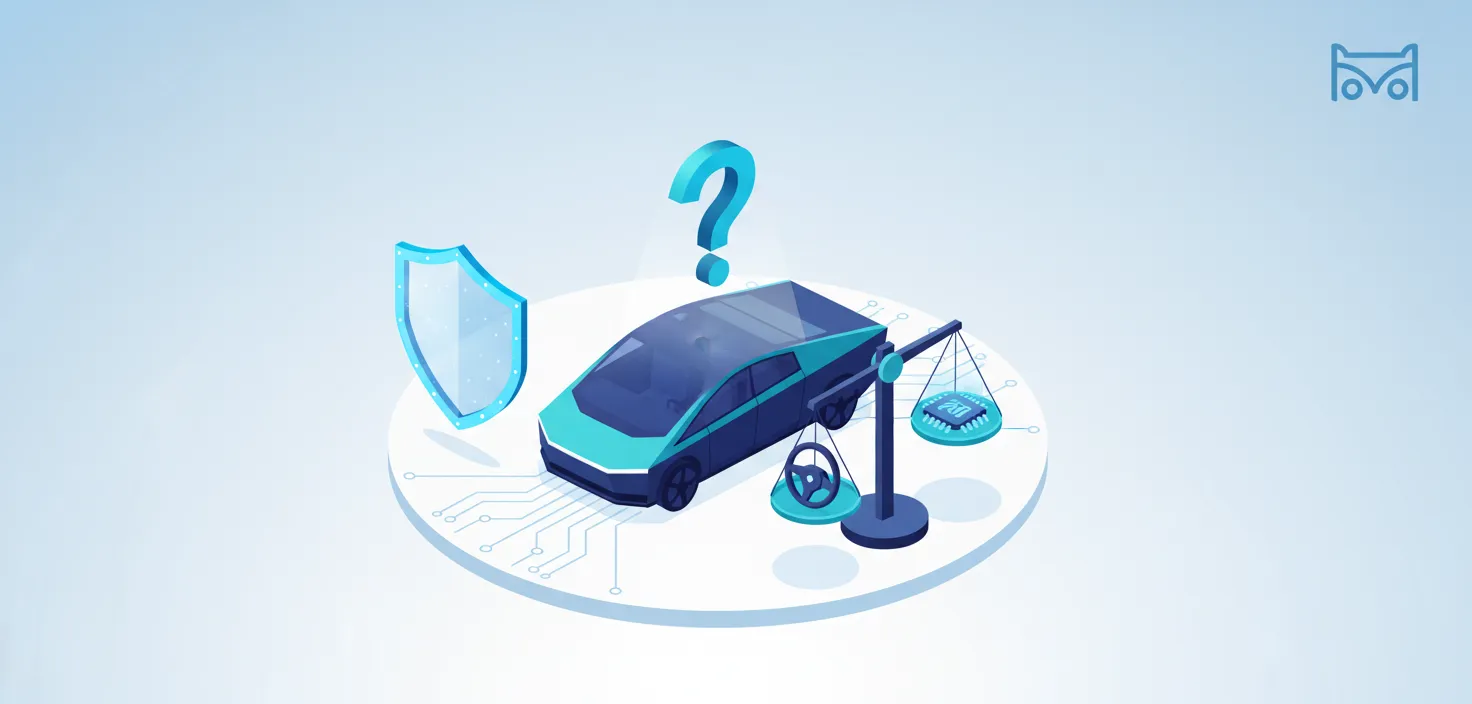
Tesla's Cybercab robotaxi launched in Austin in June 2025 and entered mass production in early 2026 — but auto insurance for autonomous vehicles remains a legal and financial gray area. Traditional insurers are ill-prepared, crash rates are 4x higher than human drivers, and liability questions are still unsettled. Here's what you need to know before you ride (or own) one.
When Tesla first teased its Robotaxi concept back in 2019, it sounded like something out of a sci-fi movie. A fleet of driverless cars, summoned by an app, generating passive income for owners while you slept. Fast forward to 2026, and that vision has taken a very real — and very complicated — shape.
The Cybercab is real. Production has started. The robotaxi service is running in Austin. And yet, some of the most important questions — who's liable when something goes wrong? Who pays for insurance? What happens when it crashes? — still don't have clean answers.
If you're an auto insurance consumer, this matters more than you might think. The rise of autonomous vehicles is quietly reshaping the insurance industry, and the Cybercab is the clearest example of that shift.
- Tesla's Cybercab entered mass production in April 2026, priced around $30,000
- The Austin robotaxi service launched June 22, 2025 — with a rocky safety record so far
- Tesla Robotaxis crash roughly once every 62,500 miles vs. human drivers' 229,000 miles
- Traditional insurers like GEICO and Progressive are largely unprepared for self-driving coverage
- Tesla Insurance (available in 12 states) may be the default option for Cybercab owners
- Liability in accidents could fall on Tesla, the owner, or both — depending on the situation
What Is the Tesla Cybercab?
The Cybercab is Tesla's purpose-built autonomous vehicle — and it's unlike anything else on the market. There's no steering wheel. No gas pedals. No driver's seat in the traditional sense. It's a compact two-seater that's designed entirely around the idea that the car drives itself, all the time, everywhere.
Tesla unveiled the concept in August 2024 and began limited robotaxi service in Austin, Texas, in June 2025. The first Cybercab rolled off the production line at Tesla's Texas factory in early 2026, with full-scale production expected to ramp up through April 2026. Pricing is expected to come in around $30,000 — a figure Elon Musk has confirmed publicly.
The big sell? You could buy a Cybercab, put it into Tesla's ride-hailing network when you're not using it, and theoretically have it pay for itself. It's the same pitch Tesla has been making for years with its FSD (Full Self-Driving) subscription. The difference is that now there's actual hardware designed around that idea.
How It Works: Tesla FSD vs. Waymo's Approach
Not all robotaxis are built the same. There's an important technical distinction that directly affects safety — and by extension, insurance risk.
Waymo (owned by Alphabet/Google) uses what's called a multi-sensor approach: cameras, LiDAR, radar, and GPS all working together to build a detailed 3D picture of the car's surroundings. It's expensive, but it's precise.
Tesla takes a completely different approach. The Cybercab runs on a vision-only system — eight cameras and artificial intelligence, with no LiDAR or radar. Tesla argues that this is how humans navigate the world (with eyes, not laser beams), and that AI trained on billions of miles of real-world data will outperform sensor-heavy systems at scale.
That debate is real and ongoing. But the early data from the Austin robotaxi launch isn't encouraging for Tesla.
Tesla Robotaxis in Austin crashed approximately once every 62,500 miles — compared to Waymo's once every 98,600 miles and human drivers' once every 229,000 miles. Early incidents included wrong-way driving, phantom braking, and dropping passengers off in intersections.
The Insurance Problem Nobody Is Talking About
Here's the thing about autonomous vehicles and insurance: the entire framework of auto insurance in the US was built around human drivers making decisions. You get into an accident, and fault is assigned based on who was negligent — who ran the red light, who was texting, who was speeding.
When the car is doing the driving, none of that framework cleanly applies.
Who's at fault if a Cybercab makes a wrong turn and causes a crash? Is it Tesla, because they built the software? The vehicle owner, because they put it on the road? Or is it nobody's "fault" in the traditional sense — just a machine failure that someone has to compensate for?
These aren't hypothetical questions. A jury already awarded $329 million (including $200 million in punitive damages) in a fatal Tesla Autopilot crash case. The trial judge sanctioned Tesla for discovery violations. And that's with a human still technically responsible for monitoring the vehicle.
With full autonomy, the legal exposure gets even murkier.
State auto liability insurance laws still require coverage for vehicles on public roads — including autonomous ones. But most of those laws were written before self-driving cars existed. How they apply to the Cybercab is still being worked out, state by state.
Who Actually Insures a Cybercab?
Let's say you buy a Cybercab in 2026. You need insurance. You call GEICO. What happens?
Honestly? Nobody knows yet. Traditional insurers like GEICO, Progressive, and State Farm haven't developed underwriting models for fully autonomous vehicles. They don't have the actuarial data to price the risk, they don't understand the software systems involved, and they can't easily inspect or repair these vehicles the same way they can a standard car.
There are a few possible scenarios:
- Tesla Insurance: The most likely path for personal Cybercab owners. Tesla already offers insurance in 12 states with $500 million in annual premiums. Since Tesla controls the software, the repair network, and the performance data, they're uniquely positioned to underwrite autonomous vehicles. Bundling Cybercab insurance with purchase or financing would be a logical next step.
- Commercial fleet coverage: For businesses running Cybercab fleets as robotaxis, specialized products already exist: General Liability, Robotics Errors & Omissions, and Autonomous Vehicle Liability policies from specialty insurers. This is a real, functioning market today.
- Wait-and-see from traditional insurers: Most major carriers are likely to either exclude Cybercabs initially or offer limited, high-cost policies while they gather claims data.
If you're considering buying a Cybercab, check whether Tesla Insurance is available in your state before purchase. Without it, you may struggle to find affordable, comprehensive coverage from traditional carriers.
Liability: Who Pays When a Robotaxi Crashes?
This is the question that keeps insurance lawyers up at night. And it's not settled.
For a traditionally human-driven car, liability usually falls on the driver (and therefore their insurer). For autonomous vehicles, the liability chain gets complicated:
Manufacturer Liability (Tesla)
If the autonomous system makes a decision that leads to a crash, there's a strong argument that Tesla — as the system designer — bears product liability. The $329 million Autopilot verdict suggests courts are willing to go that direction. Tesla, however, has consistently argued that FSD is a driver-assistance tool requiring human oversight, which may not apply to the Cybercab.
Owner Liability
If you own the Cybercab and put it into service — whether for your own use or as a robotaxi — most current state laws would still hold you liable for incidents involving your vehicle. Your insurance policy would be the first line of defense, even if Tesla's software caused the problem.
Platform/Fleet Liability
For ride-hailing operations, the platform operator (Tesla, or a third-party fleet company) may carry its own commercial insurance that kicks in during active rides. Think of how Uber and Lyft handle this today — they carry supplemental commercial policies while drivers are in service.
| Scenario | Who Bears Primary Liability | Insurance Type Needed |
|---|---|---|
| Personal use Cybercab | Vehicle owner + potentially Tesla | Personal AV liability policy |
| Cybercab in fleet robotaxi service | Fleet operator + Tesla (software) | Commercial AV + E&O liability |
| Software/FSD failure proven | Tesla (product liability) | Tesla self-insurance + legal exposure |
| Active ride-hailing (platform model) | Platform operator | Commercial ride-share policy |
Tesla Robotaxi in Austin: Real-World Performance
The Austin launch in June 2025 was Tesla's first real-world test of unsupervised robotaxi service. And eight months in, the results are… mixed.
On the positive side: the service is running, people are using it, and Tesla has accumulated meaningful real-world data. The technology is advancing quickly.
On the concerning side: NHTSA data shows Tesla Robotaxis have a crash rate roughly nine times worse than human drivers in early reports — one crash every 55,000 miles in some datasets, every 62,500 in others. Waymo, by comparison, averages one incident every 98,600 miles. Human drivers are at roughly one every 229,000 miles.
Early incidents included vehicles driving on the wrong side of the road, phantom braking, and stopping in the middle of intersections. NHTSA opened investigations into several incidents. As of February 2026, availability has hovered around 19%, and many of Musk's original timeline promises have slipped.
That said, the technology is improving. Every incident generates training data. The question for the insurance industry is how quickly the safety record improves — and whether existing frameworks can keep pace.
If you use a Tesla robotaxi service, you're covered by the platform's commercial insurance during the ride — similar to how Uber or Lyft operates. You don't need your own policy as a passenger. But always confirm coverage details before your first ride in any autonomous vehicle service.
How This Changes Traditional Auto Insurance
The Cybercab and robotaxi trend isn't just a Tesla story — it's a signal of where the entire industry is headed. And it has real implications for every auto insurance consumer:
Shifting from Driver Risk to Product Risk
Today, your auto insurance rate is based largely on you — your age, your driving record, where you live. As autonomous vehicles proliferate, insurance pricing will shift toward the vehicle's technology, the manufacturer's safety record, and the software version running on the car. This is a fundamental change in how risk is assessed.
Rise of Manufacturer Insurance Products
Tesla Insurance is an early example of a trend: automakers becoming insurers. When you buy a Cybercab, you might buy insurance directly from Tesla the same way you finance through Tesla. Ford, GM, and others are exploring similar models. This reduces the role of traditional insurers in the autonomous segment.
New Coverage Categories
The insurance industry is developing entirely new product categories: Autonomous Vehicle Liability, Robotics Errors & Omissions, and what some are calling "RoboInsurance." These are specialized products designed for a world where the insured risk is a machine making decisions, not a human.
What It Means for Your Existing Policy
For now, if you drive a regular car, your insurance isn't directly affected. But as autonomous vehicles become more common, expect:
- New exclusions or endorsements related to autonomous driving features
- Rate changes as the overall accident landscape shifts
- More data-driven pricing tied to your car's onboard safety systems
- Potential discounts for vehicles with advanced ADAS features
State Regulations and Legal Landscape
The legal landscape for autonomous vehicles varies dramatically by state — which matters enormously for insurance.
Some states (California, Texas, Arizona) have been relatively permissive about AV testing and deployment. Others have stricter requirements or haven't addressed autonomous vehicles in their vehicle codes at all. The Cybercab can't operate on public roads in many states until it meets federal safety standards — and as US vehicle safety regulations were written around cars with steering wheels and pedals, Tesla may need regulatory exemptions for vehicles that don't have them.
For insurance purposes, this means coverage requirements and liability rules for Cybercabs will be different depending on which state you're in. If you're in Michigan (no-fault state), that framework will apply differently than in Texas or California. Multi-state fleet operators face a genuinely complex patchwork of requirements.
If you're considering a Cybercab purchase, check your state's current autonomous vehicle laws and whether Tesla Insurance operates in your state. Without both, you may face a coverage gap that standard policies won't fill.
Is the Cybercab a Revolution or a Risk?
The honest answer is: both.
The technology is advancing faster than most people expected a decade ago. Tesla has real robotaxis on real roads in a real city, generating real rides and real data. The Cybercab's $30,000 price point, if achievable, would put autonomous vehicles within reach of mainstream consumers in a way that Waymo's enterprise model doesn't.
But the safety record needs to improve significantly before this technology can responsibly scale. A crash rate four to nine times higher than human drivers isn't just a talking point — it's injuries, liability claims, and insurance losses that someone has to absorb. And the legal, regulatory, and insurance frameworks that society needs to safely integrate autonomous vehicles are still being built in real time.
For auto insurance consumers, the bottom line is this: the Cybercab is coming, the insurance industry is not fully ready for it, and the rules of liability are going to be contested and refined over the next several years in courts, legislatures, and insurance commission offices across the country.
Stay informed. And if you're in the market for a Cybercab, make sure you've done your homework on coverage options before you sign anything.
Frequently Asked Questions
Yes. State auto liability laws still apply to autonomous vehicles, including the Cybercab. However, traditional insurers may not yet offer coverage for fully autonomous vehicles. Tesla Insurance, available in 12 states, is currently the most practical option for personal Cybercab owners. Check availability in your state before purchasing.
Liability is genuinely unsettled. In most cases, it could fall on the vehicle owner, Tesla (as software manufacturer), or the fleet operator — sometimes all three. Courts are actively developing precedent in this area. A 2024 Autopilot crash resulted in a $329 million verdict against Tesla, signaling that manufacturers face significant exposure even under driver-oversight frameworks.
Tesla uses a vision-only (camera + AI) system, while Waymo uses a multi-sensor approach combining cameras, LiDAR, and radar. Currently, Waymo has a better safety record — crashing roughly once every 98,600 miles compared to Tesla's approximate once every 62,500 miles. However, Tesla's system is more scalable and lower-cost, which could give it long-term advantages as AI continues to improve.
Most standard personal auto policies weren't written to cover fully autonomous vehicles, and many include exclusions for vehicles operating without human control. You'll want to review your policy carefully and contact your insurer directly. For fully autonomous vehicles like the Cybercab, you'll likely need a specialized policy or coverage through Tesla Insurance.
As of early 2026, Tesla Insurance operates in approximately 12 U.S. states. You can check current availability at tesla.com/insurance. Tesla has been expanding its insurance program and may add states as demand for Cybercab grows.
- CleanTechnica - The Tesla Cybercab Is Here. Now What? (February 2026)
- Koop.ai - Tesla's Cybercab and Robovan Are Impossible Without This (Insurance Analysis)
- TechRadar - Tesla Robotaxis Crashing Four Times More Than Human Drivers
- Electrek - Tesla Robotaxi Status Check: 8 Months In (February 2026)
- Insurance Journal - Tesla Targets June 12 Launch of Robotaxi Service in Austin
- NHTSA - Autonomous Vehicle Safety Research Data