
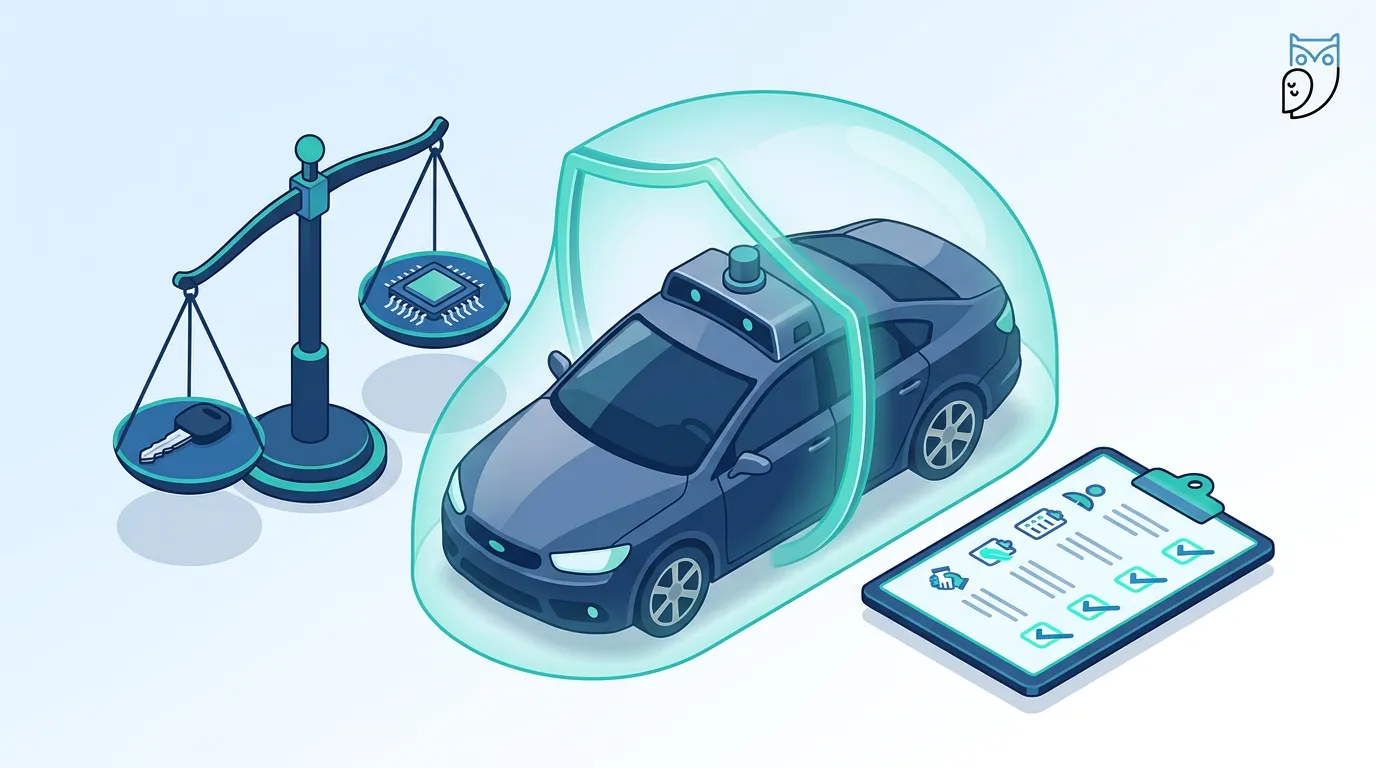
Self-driving cars are still covered under standard auto insurance policies in 2026, but the rules are evolving fast. For most vehicles with partial automation (Tesla Autopilot, GM Super Cruise), your regular liability policy applies. But as true autonomy arrives, liability is shifting from drivers to manufacturers — and new specialized products like Lemonade's Tesla FSD coverage are already here.
The future of driving is already here — just not in the way movies predicted. You won't find a fully autonomous taxi driving itself across the country with no one behind the wheel. What you will find is a growing number of vehicles packed with cameras, sensors, and AI that can keep you in your lane, brake before you react, and even navigate highways with their hands off the wheel.
That raises a pretty important question: what happens to your car insurance?
The short answer is that insurance is catching up — quickly. And if you own a Tesla, a newer BMW, or any vehicle with advanced driver-assistance systems, understanding how this technology intersects with your coverage could save you money and protect you from a nasty surprise after an accident.
- All vehicles — even those with advanced automation — must carry state-required minimum insurance coverage
- As of 2026, most consumer vehicles are Level 2 autonomous (driver assistance, not full self-driving)
- Lemonade launched the first specialized insurance for Tesla Full Self-Driving customers in January 2026
- When autonomous systems cause crashes at Level 3+, liability increasingly shifts to the manufacturer
- Repair costs for sensor-equipped vehicles can be 3-4x higher due to camera and sensor recalibration
Understanding Self-Driving Levels: What Your Car Actually Does
Before we talk insurance, let's be clear about what "self-driving" actually means. The Society of Automotive Engineers (SAE) defines six levels of vehicle automation, and they matter enormously when it comes to liability and coverage.
- Level 0 — No automation. You're fully in control at all times.
- Level 1 — Driver assistance. Features like adaptive cruise control or lane-keeping assist, but only one at a time.
- Level 2 — Partial automation. The car handles steering AND acceleration/braking simultaneously, but you must stay alert and supervise. Tesla Autopilot, GM Super Cruise, and BMW Highway Assistant all fall here.
- Level 3 — Conditional automation. The car handles driving in specific conditions; you can look away but must respond to alerts. Honda Legend in Japan and Mercedes-Benz Drive Pilot in select U.S. states offer limited Level 3.
- Level 4 — High automation. The car handles everything within a defined geographic area without human intervention. Waymo's robotaxis in Phoenix and San Francisco operate at this level.
- Level 5 — Full automation. Drives itself anywhere, anytime, with zero human input needed. Not yet available for consumer purchase anywhere in the world.
Despite aggressive marketing language from automakers, no consumer vehicle sold in the U.S. as of 2026 is fully autonomous. Tesla's "Full Self-Driving" is a Level 2 system — the driver must remain engaged and supervise at all times.
Most Americans on the road today have Level 1 or Level 2 systems. That matters because at these levels, you're still legally responsible for what the car does.
Self-Driving Car Insurance Today: What You Actually Need
Here's something most drivers don't realize: there are no special insurance requirements for cars with autonomous features as of mid-2025. Your standard auto insurance policy covers your Tesla Model 3, your Subaru with EyeSight, or your Cadillac with Super Cruise — same as any other vehicle.
What does change is how claims get handled when something goes wrong.
Let's say your car's automatic emergency braking fires at the wrong time and rear-ends the car in front of you. Was that the car's fault? Yours? Your insurer will investigate, and increasingly those investigations pull data from the vehicle's onboard computers. Modern cars are rolling data recorders — they log speed, steering inputs, braking events, and whether driver-assist systems were active at the moment of impact.
New in 2026: Lemonade's Tesla FSD-Specific Insurance
In January 2026, something genuinely new happened in the auto insurance world: Lemonade launched a specialized insurance product designed specifically for Tesla Full Self-Driving customers.
Here's what makes it remarkable. Lemonade worked directly with Tesla to access vehicle telemetry data that wasn't previously available to any insurer. The product offers discounts for every mile driven in FSD mode — the premise being that when the car is driving autonomously, the risk profile is meaningfully different, and the insurer can price that accordingly.
The product launched in Arizona first and expanded to Oregon in late February 2026, with more states in the pipeline. It's an early preview of where the whole industry is heading: usage-based policies that draw a hard line between human-controlled and AI-controlled miles.
If you own a Tesla and use Full Self-Driving regularly, Lemonade's new coverage is worth checking out. Drivers who rack up a significant share of their miles in FSD mode could see real premium savings based on the split between autonomous and manual driving time.
Who's Liable When a Self-Driving Car Crashes?
This is the big question — and honestly, it's one the legal system is still figuring out in real time.
For Level 2 vehicles, the answer is almost always: the driver. Tesla has consistently maintained that Autopilot requires driver supervision and that drivers bear responsibility for accidents. Courts have largely agreed, though Tesla has faced significant regulatory scrutiny from NHTSA over Autopilot-related crashes.
For Level 3 and above, the picture shifts. When a system is specifically designed to remove the driver from the control loop, the argument that the driver should be liable gets much weaker. Fitch Ratings issued a warning in February 2026 about a structural shift as AV liability migrates toward manufacturers and technology providers.
Think of it this way: if you buy a piece of equipment and it malfunctions and hurts someone, product liability law points at the manufacturer. When a car's software makes a decision that causes a crash — without the driver in the loop — the same logic increasingly applies. Automakers and software developers know this, and it's partly why truly autonomous consumer vehicles have been slow to reach the market.
Some Level 2 systems disengage automatically when they detect driver inattention — but the disengagement itself can cause accidents if the driver isn't ready to take control. Before you rely on your vehicle's automation, understand exactly how and when it hands back control.
Why Autonomous Vehicle Repairs Cost So Much More
Autonomous vehicles are basically rolling computers. That Subaru with forward collision warning has cameras mounted behind the windshield. That Tesla has ultrasonic sensors, radar, and eight external cameras. Your BMW with Level 2 automation has a LiDAR system requiring precise calibration to function properly.
When any of those components get damaged — even in a minor fender-bender — the cost isn't just fixing the physical part. It's recalibrating the entire sensor suite to factory specifications. A windshield replacement that once cost $300 can now exceed $1,200 on a camera-equipped vehicle. A front bumper with an embedded radar module can run $2,500 or more after recalibration.
| Repair Type | Traditional Vehicle | ADAS-Equipped Vehicle |
|---|---|---|
| Windshield replacement | $200–$400 | $800–$1,500+ |
| Front bumper repair | $500–$1,200 | $1,500–$3,500+ |
| Minor fender-bender | $500–$900 | $1,200–$2,500+ |
| Side mirror replacement | $150–$350 | $400–$900+ |
The bottom line: if you drive a vehicle with advanced automation features, your collision and comprehensive coverage limits matter more than they used to. Carrying low limits because "it's just a small car" is a mistake when sensor recalibration alone can add hundreds of dollars to any claim.
State Regulations: A Patchwork of Rules Across the U.S.
Auto insurance is state-regulated, and that creates a challenging environment as autonomous vehicles become more common. Different states have taken very different approaches, and where an accident happens matters a lot for how liability plays out.
- California — Among the most active AV regulators. Requires permits for autonomous vehicle testing and deployment, and the DMV has broad authority over AV operations. Waymo's robotaxi service operates under heavy oversight here.
- Arizona — More permissive environment, which is partly why Waymo launched its service there first and why Lemonade chose Arizona for its Tesla FSD insurance pilot in early 2026.
- Texas — Generally permissive toward AV deployment; no comprehensive state-level AV legislation as of early 2026.
- Michigan — A major automotive state with active AV legislative frameworks given its ties to the auto industry.
Insurance remains state-regulated, and the rules around autonomous vehicle liability vary widely. There's growing pressure for federal standards to prevent a patchwork of 50 different frameworks — but no comprehensive federal AV legislation has passed as of early 2026.
How Your Car's Safety Tech Affects Your Premium Today
Here's something that actually works in your favor right now: many insurers offer discounts for vehicles equipped with advanced driver-assistance systems. The logic is straightforward — a car that can automatically brake before a collision is statistically less likely to be involved in a serious accident, and insurers know it.
Research suggests that forward collision warning systems, when combined with vehicle-to-vehicle communication, could prevent up to 76% of roadway crashes. That's not lost on underwriters.
Discounts vary by insurer and state, but it's worth asking your insurer these specific questions:
- "Do you offer discounts for vehicles with automatic emergency braking?"
- "Is there a discount for ADAS-equipped vehicles?"
- "Do you have usage-based options that factor in autonomous driving miles?"
When shopping for insurance on a vehicle with automation features, don't just compare base rates. Ask each insurer specifically about their ADAS discount programs and how they handle claims involving driver-assistance systems. These details rarely show up in a standard quote comparison.
What the Future of Self-Driving Insurance Looks Like
Industry analysts at Goldman Sachs and S&P Global are tracking a slow but structurally significant transition. Fitch Ratings noted in early 2026 that it doesn't expect autonomous vehicles to meaningfully impact traditional insurers for at least another decade — but when that shift happens, it'll reshape the entire industry.
Here's the direction things are moving:
- Product liability grows larger — As Level 3+ vehicles enter the mass market, automakers will need substantial product liability coverage for accidents caused by their software. This may eventually become the dominant form of auto insurance.
- Per-mile autonomous pricing — Lemonade's Tesla FSD product is the first of many insurance products that will distinguish between human-driven and AI-driven miles. Expect this model to expand rapidly.
- Data sharing becomes standard — Insurers will increasingly partner with automakers to access real-time telemetry for both claims investigation and pricing. The driver who keeps data-sharing off may face higher premiums.
- Personal auto premiums shrink gradually — As more miles are driven autonomously, the traditional personal auto insurance market will contract. But it won't disappear — humans will still be driving for decades to come.
Let's be honest: for the average driver in 2026, your insurance needs haven't changed that dramatically. But keep a close eye on what your car's automation features mean for your coverage — this landscape is shifting faster than almost any other area of insurance.
Frequently Asked Questions
As of 2026, no — not legally. All vehicles, including those with advanced autonomous features, must carry your state's required minimum insurance. Standard policies cover ADAS-equipped vehicles just fine. However, new specialized products like Lemonade's Tesla FSD insurance are emerging and may offer better pricing for high-autonomy drivers.
It depends on the automation level. For Level 2 systems like Tesla Autopilot or GM Super Cruise, the driver is still responsible — these systems require driver supervision. For Level 3 and above, where the car can operate without driver supervision in specific conditions, liability increasingly shifts toward the vehicle manufacturer or software provider.
Not necessarily in premiums, but repair costs are significantly higher. A minor collision on an ADAS-equipped vehicle can cost 2-4x more than the same damage on a traditional car due to sensor and camera recalibration requirements. Make sure your collision coverage limits reflect the true repair cost of your specific vehicle.
Tesla's Full Self-Driving (FSD) is a Level 2 driver-assistance system — despite the name, it requires the driver to remain alert and in control at all times. In January 2026, Lemonade partnered with Tesla to offer discounted insurance for miles driven in FSD mode, making it the first product to use Tesla telemetry data for pricing.
Not anytime soon, and probably never completely. Even as vehicles become safer, someone still needs to be financially responsible when things go wrong — whether that's the driver, the carmaker, or a software company. Insurance will evolve rather than disappear, shifting from personal liability products toward product liability and manufacturer-side coverage over time.
- Insurance Information Institute — Background on Self-Driving Cars and Insurance
- NHTSA — Automated Vehicles for Safety
- TechCrunch — Lemonade Launches Insurance for Tesla FSD Customers (January 2026)
- Insurance Journal — Fitch: 10-Year Wait for AVs to Impact Insurers (February 2026)
- S&P Global — How Autonomous Vehicles Will Change the Future of Car Insurance
- Progressive Insurance — Insurance for Self-Driving Cars