
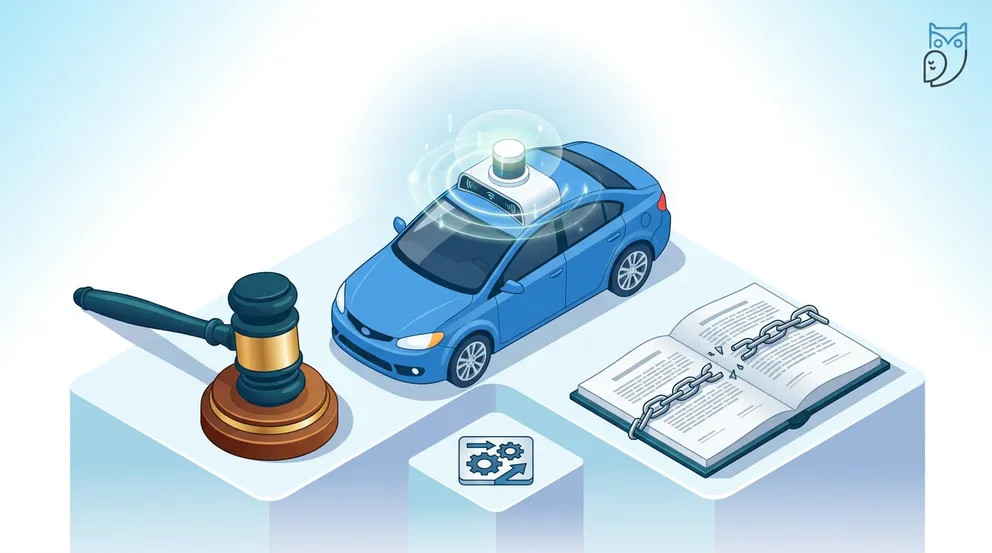
At SAE Level 2 systems like Tesla Autopilot, Ford BlueCruise, and GM Super Cruise, the human driver remains legally liable when something goes wrong. At Level 3 and above, liability shifts to the manufacturer while the automated system is engaged. California requires $5 million minimum coverage for Level 4-5 vehicles, while Florida requires $1 million for fully autonomous vehicles, per the Insurance Institute for Highway Safety.
Self-driving cars now make up a small but growing share of US road traffic. Waymo completes 450,000 weekly driverless rides across six cities, and Tesla owners log millions of miles every day using Full Self-Driving (Supervised), per a November 2025 TechCrunch report. When one of these vehicles causes a crash, the question of who pays gets complicated fast.
The answer depends on the SAE automation level engaged at the moment of impact, the state where the crash happened, and whether the system or the human had control. Forty-two states plus Washington DC have passed legislation governing autonomous vehicles, with financial responsibility minimums ranging from standard nonautomated coverage to $5 million per vehicle, per the Insurance Institute for Highway Safety. Liability assignment differs sharply across those rules.
How Autonomous Vehicle Liability Works in 2026
Society of Automotive Engineers (SAE) standard J3016 defines six levels of driving automation, from Level 0 (manual) to Level 5 (full autonomy with no human input). US regulators and insurers price coverage based on which level was active during a crash.
The lower the level, the more the human pays. The higher the level, the more the manufacturer pays.
SAE Levels 0-2: The Driver Stays Liable
Tesla Autopilot, Tesla Full Self-Driving (Supervised), Ford BlueCruise, GM Super Cruise, and most Honda Sensing features all operate at Level 2. NHTSA classifies these as driver-assistance, not automated driving. Marketing language sometimes blurs this distinction, but the legal framework does not.
When a Tesla running Autopilot rear-ends another vehicle, the driver carries legal responsibility under standard negligence law. Tesla strenuously warns drivers they must remain attentive and ready to take over at any moment, which keeps the manufacturer shielded from most direct negligence claims. Your personal auto policy pays the same way it would for any at-fault accident, per existing self-driving car insurance rules.
Two Ford Mustang Mach-E vehicles using BlueCruise struck stationary cars at night in fatal crashes investigated by NHTSA. Each one was treated as a driver-supervision failure rather than a manufacturer defect.
SAE Level 3: The Conditional Handoff
Level 3 is where the legal handoff actually happens. Mercedes-Benz Drive Pilot became the first Level 3 system approved for public roads in the US, launching in Nevada in 2023 and California in 2024. Mercedes publicly committed to assume legal responsibility whenever Drive Pilot is engaged, the first manufacturer to do so.
Mercedes scrapped Drive Pilot with the upcoming S-Class refresh, blaming "lackluster demand and high costs" according to Autoevolution. The cancellation does not undo the liability framework Mercedes set, which serves as the regulatory blueprint for any future Level 3 system in the US.
When a Level 3 system asks the driver to take over and the human fails to respond, liability returns to the driver. Insurers pull data logs from the vehicle to determine who held control at the moment of impact.
SAE Levels 4 and 5: The Manufacturer Owns It
Waymo operates Level 4 vehicles with no human driver across six US cities and reports 450,000 weekly driverless rides as of November 2025, per TechCrunch. When a Waymo crashes, Waymo's own commercial policy pays the claim. Volvo, Google, and Mercedes have each publicly stated they will cover injuries and property damage caused by their Level 4 and Level 5 vehicles.
Goldman Sachs predicts autonomous vehicles will cut personal auto insurance costs roughly 50% by 2040, since most claims will migrate from personal policies to product liability coverage held by manufacturers, per Fortune's June 2025 report. Insurance Institute for Highway Safety expects about 4.5 million self-driving vehicles on US roads by 2030.
State Minimum Coverage Requirements for Autonomous Vehicles
State legislatures set their own financial responsibility rules for autonomous vehicles. The Insurance Institute for Highway Safety tracks every state law and the coverage minimum that comes with it.
| State | AV Coverage Minimum | Status | vs. Average Personal Policy ($50K) |
|---|---|---|---|
| California | $5,000,000 | Level 4-5 deployment | 100x |
| Arkansas | $750K-$5M | Tiered by vehicle type | 15-100x |
| Louisiana | $2,000,000 | Commercial only | 40x |
| Florida | $1,000,000 | On-demand AV networks | 20x |
| Kentucky | $1,000,000 | Deployment allowed | 20x |
| Alabama | $100K-$2M | Tiered by operator | 2-40x |
| Georgia, Iowa, Kansas | Standard auto minimum | No special AV minimum | 1x |
Source: Insurance Institute for Highway Safety, Highly Automated Vehicle Laws database, current as of 2026. Comparison column uses the typical state personal auto liability minimum of $25,000/$50,000.
Nevada, Texas, Pennsylvania, and Utah set $1M to $5M ranges depending on whether the vehicle operates as a passenger taxi or a delivery service. California's regulatory approach is the strictest, but states like Georgia, Iowa, and Kansas treat AVs the same as standard cars for insurance purposes.
The state minimum covers third parties hit by the AV, not the passenger riding inside. If you're injured in a Waymo crash in California, you file a claim against Waymo's $5 million policy. If you own a Tesla and crash while using FSD, your personal policy handles your medical bills the same way it would for any other crash.
What Tesla, Waymo, Mercedes, and Ford Each Say About Liability
Every manufacturer takes its own position on responsibility when their automated systems are running.
| Manufacturer | System | SAE Level | Who Pays the Claim |
|---|---|---|---|
| Tesla | FSD (Supervised), Autopilot | Level 2 | Driver's personal policy |
| Waymo | Waymo Driver | Level 4 | Waymo commercial policy |
| Mercedes-Benz | Drive Pilot (engaged) | Level 3 | Mercedes liability policy |
| Ford | BlueCruise | Level 2 | Driver's personal policy |
| GM | Super Cruise | Level 2 | Driver's personal policy |
| Volvo | EX90 with Ride Pilot | Level 3 (planned) | Volvo liability when engaged |
Source: Manufacturer public statements, IIHS Highly Automated Vehicle Laws database, NHTSA Standing General Order filings, 2024-2026.
Tesla published detailed safety data on November 14, 2025, showing FSD-supervised drivers travel 2.9 million miles between major collisions versus 505,000 miles for the average US driver, per TechCrunch. The numbers do not change Tesla's legal position. Tesla's Cybercab robotaxi service, which Tesla plans to operate without a human driver, will move Tesla into Level 4 territory and shift liability onto Tesla directly.
A 2019 Tesla Autopilot crash in Key Largo resulted in $243 million in damages, with Tesla found 33% responsible for the fatality. The verdict marked the first time a US jury assigned partial liability to Tesla for a Level 2 crash, signaling that even with the driver-liable framework, manufacturers can face product liability exposure.
How Self-Driving Cars Have Crashed: The 2024-2025 Numbers
NHTSA mandated crash reporting from operators of automated driving systems and Level 2 advanced driver assistance systems in June 2021, producing the first systematic data on AV safety in the US.
| Brand | System Type | NHTSA Crashes Reported | Notable Outcomes |
|---|---|---|---|
| Tesla | ADAS (Level 2) | 2,093 | NHTSA Preliminary Evaluation opened Oct 2025 |
| Waymo | ADS (Level 4) | 907 | 1 fatality across 56.7M rider-only miles |
| Cruise (defunct) | ADS (Level 4) | 155 | Service shut down 2025 |
| Honda | ADAS | 112 | Mostly Sensing system incidents |
| Subaru | ADAS | 47 | EyeSight system incidents |
Source: NHTSA Standing General Order crash database, compiled via FinanceBuzz Self-Driving Car Statistics 2025. Cumulative crash counts through 2025; reporting requirements began June 2021.
Self-driving car crashes nearly doubled from 288 in 2023 to 544 in 2024, with semi-autonomous incidents rising 35% year over year. The growth tracks rising adoption rather than declining safety. Waymo's peer-reviewed safety study, published in 2024, found statistically significant crash-rate reductions across 56.7 million driverless miles compared to human-driven baselines.
If you're hit by a Waymo, Cruise, or other Level 4 robotaxi, request the NHTSA Standing General Order filing for the incident. Operators must file within 24 hours of crashes involving injuries or property damage above $1,000. The filing names the operator's commercial insurance carrier, which you'll need for your claim.
What Your Auto Policy Covers When AV Tech Is Engaged
If you own a Tesla, Ford, GM, Honda, or Subaru with Level 2 features, your standard auto policy pays the same way it would for a manual driving crash. The technology label does not currently change your premium structure, though some carriers offer FSD-related discounts of 5% to 15% based on telematics data, per recent industry tracking.
If you ride in a Waymo and the Waymo causes the crash, Waymo's commercial policy covers your medical bills and property damage. You file against Waymo's coverage rather than your own, the same process used for an Uber or Lyft commercial-period claim.
If you ride in a friend's Mercedes with Drive Pilot engaged and the system causes a crash, Mercedes' liability policy pays. If Drive Pilot prompts a takeover and your friend fails to respond in time, their personal auto policy pays instead.
Most personal auto policies exclude "driving for hire" or commercial use. If you use your Tesla for a future Tesla Network robotaxi service, your personal policy will likely deny coverage during commercial trips. Tesla, Uber, and Lyft drivers already face this gap, with commercial periods requiring separate rideshare endorsements or commercial policies.
How to Protect Yourself Today
Verify your liability limits
Standard state minimums of 25/50/25 will not cover a serious crash involving a Tesla or other expensive vehicle. Raise liability to 100/300/100 for about $15 to $25 more per month, per Bankrate's 2026 rate analysis.
Add uninsured motorist coverage
If a self-driving car causes a crash and the manufacturer disputes liability, your UM/UIM coverage fills the gap while the legal fight plays out. About 12.6% of US drivers are uninsured, per Insurance Information Institute 2024 data.
Document every AV interaction
Photograph the vehicle, the lane markings, the time of day, and any system display visible through the windshield. NHTSA filings rely on operator-provided data, which insurance companies will challenge.
Request the data log
Tesla, Waymo, Mercedes, and Ford all record vehicle telemetry at the time of a crash. Your attorney can subpoena this data to prove whether the automated system was engaged. Some manufacturers release it voluntarily; most require legal process.
Ask your insurer about AV-related discounts
Progressive, State Farm, and Nationwide offer telematics programs that recognize FSD and Autopilot use, with discounts ranging from 5% to 30% based on driving behavior. Discounts apply to the human's record, not the system's.
The long-term picture is still in motion. Will self-driving cars eliminate personal auto insurance? Industry forecasts suggest a 50% reduction in personal coverage by 2040, but the transition will run alongside personal policies for decades. KPMG projects autonomous technology could reduce accident frequency by nearly 90% by 2050, per NAIC data.
Frequently Asked Questions
It depends on the SAE automation level engaged. At Level 2 (Tesla Autopilot, Ford BlueCruise, GM Super Cruise), the driver is liable. At Level 3 with the system actively driving (Mercedes Drive Pilot), the manufacturer pays. At Level 4 (Waymo), the operator's commercial policy pays.
Yes, standard personal auto policies cover crashes while Level 2 systems are engaged, since the driver remains legally responsible. Some carriers offer 5% to 15% telematics-based discounts for Tesla FSD or Autopilot users, but coverage works the same as for manual driving.
You file a claim against the operator's commercial liability policy. California requires $5 million minimum coverage for Level 4-5 deployment, while Florida requires $1 million for on-demand AV networks. Operators must report the crash to NHTSA within 24 hours under the Standing General Order.
Eventually, yes. Goldman Sachs projects a 50% reduction in personal auto insurance costs by 2040 as crashes migrate from personal policies to manufacturer product liability coverage. Short-term, premiums have not dropped meaningfully because adoption remains below 5% of US vehicles.
Forty-two states plus Washington DC have AV laws. California requires $5 million for Level 4-5 vehicles. Florida, Kentucky, and Nevada require $1 million. Arkansas tiers from $750K to $5 million. Georgia, Iowa, and Kansas treat AVs the same as standard cars for coverage purposes.
No, Tesla's legal position is that FSD is supervised driver-assistance, so the driver remains liable. A 2019 Key Largo jury verdict assigned 33% responsibility to Tesla for one fatal Autopilot crash, totaling $243 million. Tesla is appealing. Tesla does not assume liability for Autopilot or FSD crashes by default.
- Insurance Institute for Highway Safety: Highly Automated Vehicle Laws Database (2026)
- NAIC: Autonomous Vehicles Insurance Topics
- NHTSA: Automated Driving Systems
- TechCrunch: Tesla FSD Safety Report (November 2025)
- FinanceBuzz: Self-Driving Car Statistics 2025
- Fortune: Goldman Sachs Autonomous Vehicle Insurance Forecast (June 2025)
- SAE International: J3016 Levels of Driving Automation
- Yahoo Finance / Insurify: Autonomous Car Accidents Liability Analysis (2026)