

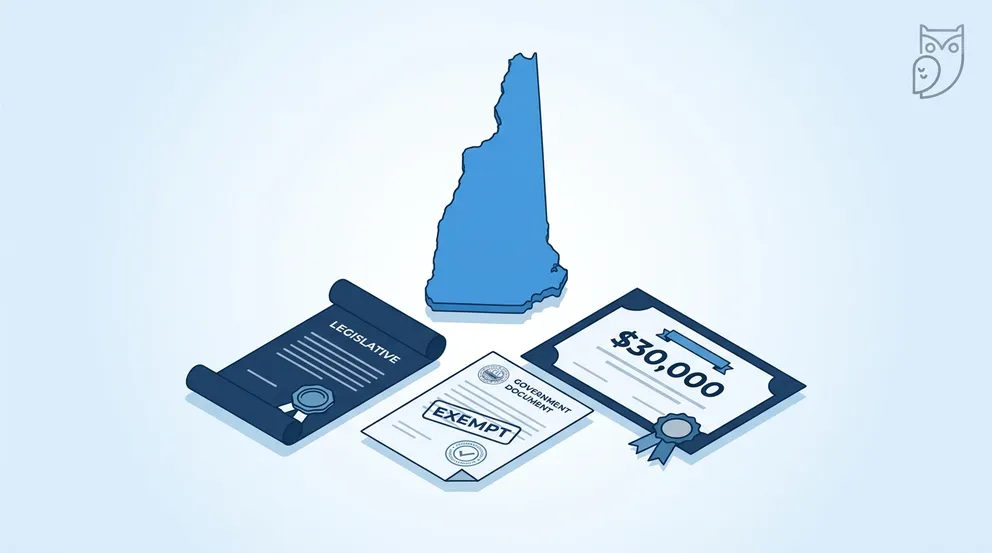
Only New Hampshire skips mandatory car insurance in 2026, according to its Insurance Department. Virginia dropped its $500 opt-out fee in 2024. Many states accept a $30,000 to $60,000 bond or cash deposit instead of a policy.
You can legally skip car insurance in exactly one state. And even there, the freedom lasts only until you're at fault in a wreck.
New Hampshire lawmakers voted down two bills to end that exception on February 19, 2026, so if you've seen an older list that names a second state, you're looking at information that's at least two years out of date.
Which States Don't Require Car Insurance in 2026?
Just New Hampshire. Every other state, plus Washington, D.C., makes you carry liability coverage or prove some other way that you can pay for the damage you do to other people.
You'll still find plenty of websites listing Virginia as a second exception. They're wrong.
Virginia's General Assembly passed SB 951 in 2023, and the uninsured motor vehicle fee option that let you register a car without a policy ended for good on July 1, 2024.
| State | Insurance Required Before July 2024? | Insurance Required in 2026? | What Changed |
|---|---|---|---|
| New Hampshire | No | No | Nothing; HB 1558 and HB 1568 died in the House on Feb. 19, 2026 |
| Virginia | No, if you paid a $500 yearly fee | Yes | Fee repealed July 1, 2024; minimums rose to 50/100/25 on Jan. 1, 2025 |
| Other 48 states and D.C. | Yes | Yes | Many still accept a bond or cash deposit instead of a policy |
Source: NH Insurance Department, Citizens Count, NH Liberty Alliance bill tracker and Virginia DMV, checked October 2026.
New Hampshire's Financial Responsibility Law
A financial responsibility law lets you drive without a policy as long as you can pay for an at-fault crash, and New Hampshire's version, the state Insurance Department says, doesn't make you carry auto insurance at all.
But you must be able to show "sufficient funds" after an at-fault accident, and if you can't, the state can suspend your driving privileges until you do.
Virginia's Uninsured Motor Vehicle Fee (Repealed)
The uninsured motor vehicle (UMV) fee was a $500 yearly charge that let Virginians register a car without insurance. It never covered a thing. You stayed personally on the hook for every dollar of damage.
Hardly anyone used it. Insurify estimated that only about 1,300 vehicles paid the fee in 2022, working backward from $650,000 in fee revenue, so the repeal touched a sliver of Virginia's drivers.
Virginia has required 50/100/25 liability limits since January 1, 2025, and if you're caught without them, the DMV suspends your license and registration until you pay a $600 noncompliance fee plus a $145 reinstatement fee.
You'll also have to file an SR-22 for three years, and our Virginia car insurance guide shows what drivers there pay for the 50/100/25 policy you now need.
How Driving Without Insurance Works in New Hampshire
Nobody asks for proof of insurance when you register a car in Concord or Nashua. The test comes later.
If you're in a crash that causes a death, an injury or more than $1,000 in combined damage, you must report it to New Hampshire's DMV in writing within 15 days.
If police at the scene can't confirm your coverage, you'll have to verify it yourself, either online or on form DSMV 385, and that's the moment uninsured drivers get caught.
If you were at fault and can't show you're able to pay the other driver's losses, you can lose your license and your registration until you settle up.
The SR-22 Requirement
Even the one state without a mandate forces some drivers to buy a policy.
New Hampshire's DMV will put you under an SR-22 filing requirement for at least three years from the crash or conviction date, and four events trigger it.
- An at-fault crash you couldn't pay for
- Any DWI conviction, first offense included
- You leave the scene of an accident.
- A second reckless operation conviction lands on your record.
Don't own a car but still need the filing? The state accepts an Operator's SR-22, which insures your license rather than a vehicle, and a non-owner policy is the usual way you'd get one.
What a New Hampshire Policy Must Include
Most Granite State drivers buy coverage anyway; roughly 90% of registered cars there are insured, the Concord Monitor reported in January 2026.
Once you buy a policy, though, state law sets a floor on what it must include, and you can compare that floor below with Virginia, which now requires twice the bodily injury limits.
| Coverage | New Hampshire (If You Insure) | Virginia (Mandatory) | Virginia vs. NH |
|---|---|---|---|
| Bodily injury, per person | $25,000 | $50,000 | 2x higher |
| Bodily injury, per accident | $50,000 | $100,000 | 2x higher |
| Property damage | $25,000 | $25,000 | Same |
| Medical payments | $1,000 | Not required | NH only |
| Uninsured motorist | Equal to your liability limits | Required, at least 50/100/25 | Both require it |
Source: NH Insurance Department consumer guide and RSA 264:16 (medical payments); Virginia DMV; limits shown are legal minimums, not recommendations.
The Math on Skipping Coverage
Liability-only insurance in New Hampshire averages $52 a month, or $624 a year, according to Insurify's October 2026 data, which makes it among the cheapest in the country against a national average of $143 a month for all policies.
Now price a single crash. Triple-I puts the average 2024 bodily injury liability claim at $28,278 and the average property damage claim at $6,770.
That's 56 years of New Hampshire liability premiums, gone in one afternoon. And that's an average crash.
Going bare isn't a savings plan. It's a $624-a-year bet that you'll never be at fault for a $35,048 crash.
New Hampshire Rejected Mandatory Insurance Again in 2026
Two House bills tried to close the exception during the 2026 session, and both would have tied your registration to proof of coverage. Neither survived.
- HB 1568, from Representatives Barton and Graf, would have required 25/50/25 liability at registration starting January 1, 2027, with civil penalties of $250 for a first offense and $500 after that.
- Under HB 1558, you'd have shown proof of insurance or a bond to register, and the state could have suspended your registration without it.
The House Commerce and Consumer Affairs Committee voted 13-2 that HB 1568 was "inexpedient to legislate," the full House agreed on February 19, and committee chair John Hunt (R-Rindge) told the Concord Monitor the current model works.
He has a point. The Insurance Research Council estimates 10.0% of New Hampshire drivers were uninsured in 2023, below the 15.4% national rate, and 37 states plus D.C., all with full mandates in 2023, posted higher rates.
| State | Insurance Mandatory? | Uninsured Drivers (2023) | vs. National Rate (15.4%) |
|---|---|---|---|
| Maine | Yes | 5.7% | -9.7 points |
| Massachusetts | Yes | 7.9% | -7.5 points |
| New Hampshire | No | 10.0% | -5.4 points |
| Vermont | Yes | 11.8% | -3.6 points |
| Virginia | Fee option until mid-2024 | 12.9% | -2.5 points |
| Florida | Yes | 20.6% | +5.2 points |
| Mississippi | Yes | 28.2% | +12.8 points |
Source: Insurance Research Council, Uninsured and Underinsured Motorists: 2017-2023 (2025), state estimates based on the ratio of uninsured motorist claims to bodily injury claims. New Hampshire ranks 12th lowest of 50 states and D.C.
So a mandate alone doesn't get people insured. Mississippi requires coverage and still had more than 1 in 4 drivers uninsured in 2023, which is why uninsured motorist coverage pays off for you in every state.
Our ranking of states with the most uninsured drivers has the full list.
Alternatives to Car Insurance in States That Require It
A mandate doesn't always mean you need a policy, because many states let you prove you can cover a claim yourself, and each method has its own legal name.
Surety Bond (Auto Insurance Bond)
A surety bond is a bonding company's promise to pay valid claims against you, up to the bond amount, and California, for one, accepts a $35,000 bond from a California-licensed surety, the state DMV says.
The catch? A bond isn't insurance. If the surety pays a $20,000 claim, it'll expect all $20,000 back from you.
Ohio takes a $30,000 bond from a surety company, or a real estate bond backed by at least $60,000 of equity held by two owners, while Washington sets its bond minimum at $60,000.
Cash or Securities Deposit
With a cash deposit, you hand money to the state, which holds it to pay judgments against you and gives you a certificate to show as proof.
- Texas wants $55,000 in cash or qualifying securities with the state Comptroller, under Transportation Code 601.122.
- In Arizona, it's $40,000 in cash or CDs with the State Treasurer, and one certificate can cover up to 25 noncommercial vehicles.
- Ohio's figure is $30,000, held by the Treasurer of State.
- Washington: a certificate of deposit of at least $60,000.
Texas will cost you the most. A 2014 opinion from the Texas Attorney General (GA-1068) concluded that each registered vehicle needs its own $55,000 deposit, because the law ties financial responsibility to a specific vehicle rather than to you.
Own two cars? That's $110,000 sitting with the state.
Ohio adds a twist you won't like. The BMV's application form says interest on your deposit goes to the state's General Fund, and you waive any claim to it.
Run the numbers. If your $30,000 could earn 4% in a savings account, you're giving up about $1,200 a year, which is roughly what a liability-only policy costs at Insurify's October 2026 national average of $99 a month.
Self-Insurance Certificate
A certificate of self-insurance is built for fleets, not families. Ohio limits it to owners of more than 25 vehicles and Washington's DOL starts at 26, so unless you run a delivery business, it's off the table for you.
| State | Bond or Deposit Amount | Minimum Liability Limits | Most a Minimum Policy Pays Per Crash | Deposit as % of Policy Maximum |
|---|---|---|---|---|
| Ohio | $30,000 | 25/50/25 | $75,000 | 40% |
| California | $35,000 | 30/60/15 | $75,000 | 47% |
| Arizona | $40,000 | 25/50/15 | $65,000 | 62% |
| Texas | $55,000 per vehicle | 30/60/25 | $85,000 | 65% |
| Washington | $60,000 | 25/50/10 | $60,000 | 100% |
Source: California DMV (FFVR 18), Arizona State Treasurer, Texas Transportation Code 601.122, Ohio BMV Form 3146 and Washington DOL, checked October 2026; policy maximum adds the per-accident injury and property limits.
Look at Ohio's row. A $30,000 deposit backs just 40% of what the cheapest legal policy would pay on one bad crash, so any judgment above it lands on you.
- No monthly premium to pay
- If you never cause an accident, a cash deposit stays your money.
- Makes sense for drivers with six-figure liquid savings
- Ties up $30,000 to $60,000, and Texas charges that per vehicle
- Your own car and medical bills get nothing.
- A surety will chase you to repay every claim it covers
- Your lender won't accept it on a financed or leased car
No State Requires Full Coverage
You might also be searching for states that don't require full coverage. The answer is all of them, since no state law anywhere makes you buy collision or comprehensive coverage.
Your lender does, though. Finance or lease a car and the contract will demand both, since Triple-I's 2024 averages put a collision claim at $5,489 and a comprehensive claim at $2,306.
Own your car outright? Then those two are your call. Our guide on how much car insurance you need walks through when dropping them makes sense, and the 12 no-fault states also add personal injury protection to your required list.
Penalties for Driving Uninsured in Mandatory States
Outside New Hampshire, getting caught uninsured costs you fast. Washington's DOL warns of a fine of $550 or more, and Virginia's $600 noncompliance fee comes before you can even reinstate.
If you live in Tennessee, it's about to get worse. Public Chapter 1077 raises the fee for a continued coverage lapse from $100 to $1,000 on July 1, 2027, as we covered in our Tennessee uninsured driver penalties report.
Moving to New Hampshire doesn't cancel an SR-22 order from your old state. Keep filing for the full term, or that state can suspend your license, and a suspension elsewhere can block you from getting a New Hampshire license.
For fines, suspension periods and SR-22 rules in all 50 states, check our car insurance requirements by state guide.
Should You Skip Car Insurance in New Hampshire?
Honestly, almost never. The law lets you, but the $35,048 average crash bill makes it a bad trade for you unless you're sitting on serious cash reserves you'd be comfortable losing.
Count Your Liquid Cash
Add up the cash you could hand a stranger tomorrow without selling your house or draining a retirement account. Under $35,048? Then one average crash would wipe you out.
Price a Liability-Only Policy
Progressive averages $47 a month for NH liability-only coverage, per Insurify, so compare at least three quotes before you decide you can't afford one.
Keep Uninsured Motorist Protection
About 1 in 10 New Hampshire drivers has no coverage, and every NH policy you buy includes UM at your liability limits.
Read Your Loan Contract
Financed or leased? Your lender requires collision and comprehensive no matter what state law says.
If cost is what's pushing you toward going bare, start with our New Hampshire car insurance rates page and the Progressive review. A $47 policy is a lot cheaper than a lawsuit.
Frequently Asked Questions
Only New Hampshire. The other 49 states and D.C. require liability coverage or an alternative, such as a bond or cash deposit. In New Hampshire, you must still prove you can pay for an at-fault crash or lose your license.
Yes. Virginia repealed its $500 uninsured motor vehicle fee on July 1, 2024. You now need at least 50/100/25 liability. Driving uninsured costs a $600 noncompliance fee, a $145 reinstatement fee and three years of SR-22 filing.
Yes, it's legal. But if you cause a crash and can't pay the other driver's losses, New Hampshire suspends your license and registration. You'll then need an SR-22 for at least three years.
Often, yes. California accepts a $35,000 bond, Ohio $30,000 and Washington $60,000. But a bond only guarantees payment to the other party. The surety will ask you to repay any claim it covers, and it never pays for your car.
Report it to the DMV within 15 days, then show you can pay the damages, which averaged $35,048 for one injury claim plus one property claim in 2024, per Triple-I. Can't pay? You lose your license and registration.
No. No state law requires collision or comprehensive coverage. Lenders and leasing companies do, so if you finance or lease a car you'll need both until the loan is paid off.
- New Hampshire Insurance Department - Automobile Insurance Consumer Guide
- New Hampshire DMV - Insurance Requirements/SR-22 FAQs
- New Hampshire DMV - Accident Reports and Insurance Verification
- Concord Monitor - New Hampshire Likely to Kill Another Attempt at Mandating Car Insurance (January 2026)
- NH Liberty Alliance Bill Tracker - HB 1568 (2026) Action History
- Citizens Count - HB 1558 (2026)
- Insurify - Virginia Repeals Uninsured Motorist Fee
- Virginia DMV - New Laws Take Effect July 1, 2024
- MoneyGeek - Uninsured Motorist Rates by State (Insurance Research Council 2023 Data)
- Insurance Information Institute - Facts and Statistics: Auto Insurance
- Insurify - New Hampshire Car Insurance Rates (October 2026)
- California DMV - Financial Responsibility Requirements (FFVR 18)
- Texas Transportation Code Section 601.122 - Deposit With Comptroller
- Ohio BMV - Form 3146, Certificate of Financial Responsibility Deposit
- Arizona State Treasurer - Financial Responsibility Deposit Instructions
- Washington DOL - Mandatory Insurance