

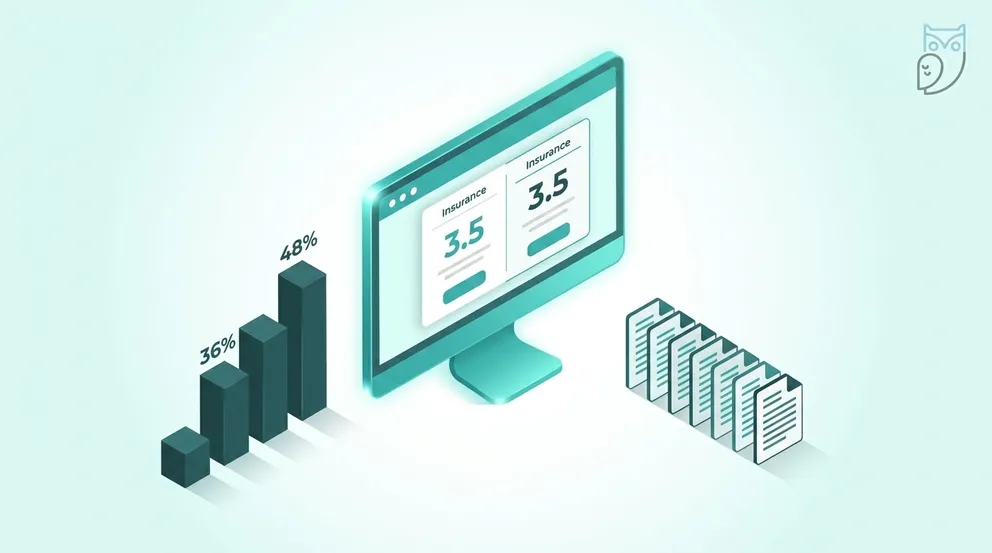
Nearly half of all new auto insurance policies are now purchased online, according to the J.D. Power 2026 U.S. Insurance Shopping Study released June 4. Digital channels handled 48% of new auto sales, up from 36% just five years ago.
Shoppers also collected an average of 3.5 quotes, the most in the study's 20-year history, as mobile apps and AI tools made price comparison faster than ever. For drivers, comparing carriers has never been easier, and skipping that step can cost hundreds of dollars a year.
- 48% of new auto policies were bought online in 2026, up from 36% in 2021, per J.D. Power.
- Shoppers averaged a record 3.5 quotes each, the highest in the study's 20-year run.
- The share of drivers shopping fell from 57% to 53% year over year as rate hikes cooled.
- AI users switch insurers more often and report higher confidence in their pick.
- Comparing three carriers saves about $709 a year, MoneyGeek data shows.
The Numbers Behind the Shift
The study, fielded from January 2025 through January 2026, surveyed 12,437 customers who had requested an auto quote in the prior six months. Its headline finding tracks a steady migration from agents and call centers to screens.
Digital purchases climbed 12 points in five years, from 36% to 48%. Quote volume rose alongside that jump, because downloading a competing carrier's app now takes seconds rather than a phone call. Many drivers install several insurer apps at once just to test rates against their current premium.
| Metric | 2026 | Prior reading | Change |
|---|---|---|---|
| New policies bought online | 48% | 36% (2021) | +12 pts |
| Average quotes per shopper | 3.5 | Below 3.5 (prior years) | Record high |
| Share of drivers shopping | 53% | 57% (2025) | -4 pts |
Source: J.D. Power 2026 U.S. Insurance Shopping Study, now in its 20th year, based on 12,437 customers who requested an auto insurance quote from at least one competing insurer in the prior six months. Fielded January 2025 through January 2026.
What the Shift Means for Your Wallet
A record 3.5 quotes per shopper only pays off if drivers act on the cheapest one. Comparing prices from at least three companies saves the average driver about $709 a year, according to MoneyGeek, and Insurify pegs the upside as high as $1,100 for some profiles.
Bankrate put the national full-coverage average at $2,697 a year ($225 a month) in June 2026, so a $709 cut trims roughly 26% off the typical premium. Even the average 3.5 quotes leaves money on the table, because each additional carrier you check can surface a lower number.
The share of drivers shopping dropped from 57% to 53% as the wave of rate increases eased, yet 53% stays high by historical standards, a sign that price hunting is now a habit rather than a panic reaction. Drivers comparing options today can line up the top-rated carriers for 2026 instead of renewing at face value.
AI Is Becoming the New Shopping Assistant
The bigger story sits beneath the digital headline. J.D. Power found that shoppers who lean on AI tools during their search switch insurers more often and feel more confident in the policy they pick.
"We're moving from a crisis-driven market to a digital and AI-driven market," said Stephen Crewdson, managing director of insurance intelligence at J.D. Power. "Even as rate pressure eases, customers are getting more quotes than ever because mobile apps and AI tools make it so much easier to compare options and understand coverage."
That confidence matters because coverage confuses people. An AI assistant can explain the gap between a $500 and a $1,000 deductible, or flag why dropping collision on an older car saves money, in plainer terms than a dense policy document. Use the tools to understand trade-offs, then confirm the final price with the carrier directly, because a chatbot can summarize coverage without locking in your actual rate.
Where Drivers Shop the Hardest
A new state-level breakdown shows the 4-point national shopping decline did not land evenly. Southern markets including Oklahoma, Mississippi and Texas stayed high-shopping and high-switching, while New England states such as New Hampshire and Vermont posted low shop-and-switch rates alongside cheaper premiums and more loyal customers. Drivers in high-rate states feel more pressure to hunt for savings, which is why Texas car insurance shoppers compare carriers far more aggressively than drivers across low-cost New England.
Pay-As-You-Drive Coverage Goes Mainstream
Telematics is no longer a niche product. Usage-based insurance, which sets rates from real driving data on mileage and braking, now covers 20% of all customers and 30% of recent shoppers, J.D. Power found. Among drivers who bought from a new insurer, 34% enrolled in a usage-based program.
Interest runs even higher than enrollment. About 44% of recent shoppers called usage-based pricing important to their decision, and 36% said they would consider embedded coverage sold straight through a car dealer or automaker. Safe drivers can test a telematics discount program for a few months before committing, since most carriers quote a participation discount up front.
What You Should Do Now
Rates are softening and carriers are competing harder for new business, so a renewal notice is the worst moment to stay passive.
Pull five quotes, not 3.5
Beat the national average by gathering quotes from five or more carriers through apps and comparison sites; each extra quote can expose a rate $100 or more below your current bill.
Ask an AI tool to decode the coverage
Paste your declarations page into an AI assistant and ask it to compare deductibles and limits, then verify the cheapest real quote with the carrier before you switch.
Test a telematics program
Enroll in a usage-based option if you drive safely or under 12,000 miles a year, and switch without a coverage gap by overlapping your old and new policy start dates.
Looking Ahead
J.D. Power expects the digital share to keep climbing past 48% as insurers pour money into apps and AI chat tools to win the first click. Crewdson called those digital spaces the "battleground" where carriers now compete on clarity rather than price alone.
With a record share of drivers planning to switch in 2026, carriers will keep dangling sharper online quotes and faster app sign-ups, and the drivers who compare the most will pocket the difference.
Frequently Asked Questions
Not most, but close. J.D. Power's 2026 study found 48% of new auto policies were purchased through digital channels, up from 36% five years earlier. The other 52% still buy through agents, call centers, or a mix of online research and offline purchase.
The average shopper gets 3.5, but five or more is smarter. Comparing at least three carriers saves about $709 a year on average, per MoneyGeek, and each additional quote can surface a lower rate. There is no cost to gathering extra quotes.
J.D. Power found that shoppers who use AI tools switch insurers more often and feel more confident in their choice. AI assistants can explain deductibles, coverage limits, and trade-offs in plain language, but always confirm the final price with the carrier before switching.
The share shopping fell from 57% to 53% year over year because the surge in rate increases cooled, easing the pressure to switch. That 53% is still high by historical standards, so shopping has not stopped, just slowed.
The channel itself does not lower your rate, but online shopping makes it far easier to compare carriers, and comparison is where the savings come from. Drivers who line up multiple quotes can save $700 to $1,100 a year versus renewing without checking.
- J.D. Power - 2026 U.S. Insurance Shopping Study (June 4, 2026)
- InsuranceNewsNet - Digital Becomes the New Front Door for Auto Insurance Shopping
- ProgramBusiness - Digital Shopping Reshapes Auto Insurance Market as AI Influence Grows
- Bankrate - Average Cost of Car Insurance (June 2026)
- MoneyGeek - Compare Car Insurance
- Insurify - Compare Car Insurance Rates