

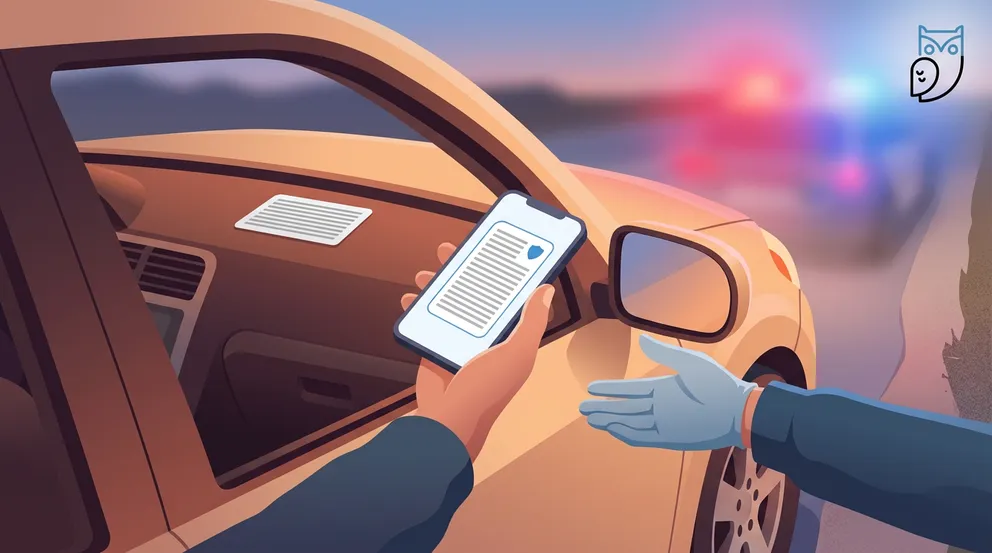
Proof of insurance is any document showing your policy was active when you're asked: an ID card, declarations page, binder or digital card on your phone. Texas courts must dismiss a no-proof charge once you show coverage valid that day.
You've got the policy. You pay for it every month. But if you can't produce the card when an officer asks, Texas can cite you for a fine of $175 to $350 under Transportation Code Section 601.191.
That ticket rarely sticks if you really were covered. This guide shows you which documents count, where your phone works as proof, statute-verified penalties in four states, and the 19 states where police can check your coverage in real time.
What Counts as Proof of Insurance?
Every state but New Hampshire makes you carry liability coverage, per Experian. Proving it's another job. Five documents can do that, and which one you'll need depends entirely on who's asking: an officer, a DMV clerk or your lender.
Insurance ID Card
Your insurance ID card is the default proof of insurance and the first thing an officer expects to see, and your insurer issues a fresh one at every renewal, on paper, as a PDF or inside its app.
- Your name and any other named insureds
- Policy number, plus your insurer's name and NAIC company code
- Effective and expiration dates. An expired card proves nothing.
- Year, make, model and VIN for every car on your policy
Check that VIN today. It's one of the keys state verification systems use to match your record, per the Kansas Legislative Research Department, so one wrong digit can trigger a lapse letter you don't deserve.
Declarations Page
Your declarations page is the summary sheet at the front of your policy, listing your limits and deductibles along with every driver and vehicle you've insured.
Texas accepts a liability policy or a photocopy of it as evidence under Section 601.053, and your dec page is part of that policy, bulkier than a card but showing your limits.
Our guide to reading your declarations page decodes every line.
Insurance Binder
An insurance binder is temporary proof of coverage your insurer issues before the formal policy documents are ready, and MoneyGeek says binders typically last 30 to 60 days.
Texas lists a binder as valid evidence in Section 601.053. You'll most likely get one at a dealership. Ask your agent to email it before you sign.
Electronic Proof of Insurance
Electronic proof of insurance is your ID card displayed on a phone, through your insurer's app, a saved PDF or a digital wallet pass.
Six big carriers support them, including GEICO and State Farm. Our Apple Wallet setup guide walks you through adding yours.
SR-22 Certificate (FR-44 in Florida and Virginia)
You don't hand an SR-22 to an officer. It's a certificate your insurer files with the state, proving you carry liability after a DUI or license suspension, and Florida and Virginia use a stricter version called the FR-44, per Experian.
Expect to carry one for three to five years, per Jerry. Our SR-22 insurance guide breaks down the cost.
Massachusetts: Proof Stamped on Your Registration
Massachusetts does it differently. Before the RMV issues your plates, your insurer certifies coverage by stamping your Registration and Title Application, as Chapter 90, Section 1A of the General Laws requires. Keep your card anyway; an officer can still ask.
Can You Show Proof of Insurance on Your Phone?
Yes, almost everywhere.
California Vehicle Code 16028 says evidence "may be provided using a mobile electronic device." Texas added "an image displayed on a wireless communication device" to its accepted list, and Florida takes proof "in a uniform paper or electronic format."
- The officer may look at your proof and nothing else, since California's 16028(g) bars "viewing any other content" on your device.
- Showing your screen isn't consent to a search (Florida 316.646, Texas 601.053).
- Drop it, crack it, and you're on the hook. California and Florida both put liability for device damage on whoever hands it over.
- Washington's RCW 46.30.030 accepts a phone image as a valid card.
New Mexico is the exception you'll see flagged most. Experian and Jerry both say it's the only state that doesn't accept electronic copies.
Lawmakers there filed bills to change that in 2017 and 2019, then tried again in 2022 with SB 113, so if you drive in New Mexico, you'll want a printed card in your glovebox.
Save your card offline before you need it. A wallet pass opens without a signal, while your insurer's app may not load on a rural shoulder with one bar, so screenshot it too and replace the screenshot at every renewal.
When You'll Need to Show Proof of Insurance
A traffic stop is the obvious one. In California, an officer writing you a ticket for almost any violation except parking must request and verify your proof under VC 16028(b), so a rolling stop doubles as an insurance check.
- After a crash, the officer and the other driver will both want your insurer and policy number, and our first 24 hours after an accident checklist covers the rest.
- Registering a car or renewing your tags.
- Lenders demand proof of full coverage on a financed or leased car.
- Rental counters may ask when you decline their coverage and plan to rely on your own policy for the rental.
- Reinstating a suspended registration or license requires current proof.
Penalties for No Proof of Insurance by State
Two offenses hide behind one phrase. Failing to show a card you have is a paperwork problem, while driving with no coverage at all can cost you $1,000 in Texas.
| State | Fine If You Can't Prove Coverage | Your Cost If You Were Insured That Day | Phone Proof Allowed? | Statute |
|---|---|---|---|---|
| California | $100 to $200 first offense, plus penalty assessments; $200 to $500 for a repeat within 3 years | $0 in statute; dismissed once the clerk receives your proof | Yes | Veh. Code 16028, 16029 |
| Texas | $175 to $350 first offense; $350 to $1,000 after a prior conviction | $0 in statute; the court "shall dismiss" after verifying your document | Yes | Transp. Code 601.191, 601.193 |
| Florida | Nonmoving infraction, $30 base penalty plus court costs | Up to $10 clerk dismissal fee | Yes | Fla. Stat. 316.646, 318.18 |
| Washington | Traffic infraction, penalty set by court rule | Up to $25 in administrative costs | Yes | RCW 46.30.020, 46.30.030 |
Source: InsureMojo review of state statutes in November 2026 (California Vehicle Code, Texas Transportation Code Chapter 601, 2025 Florida Statutes, Washington RCW Title 46); fines exclude local court costs and assessments, and individual courts may add fees.
Forgot Your Card vs. Driving Uninsured
Had coverage but no card? That's usually a fix-it ticket. Jerry puts the court fee at $25 to $100 in most states, and you'll typically get about 30 days to show proof.
With no coverage at all, you're facing the full fine.
A California judge can also order your car impounded under VC 16029(c), and getting it back means buying coverage to release the impounded car plus paying the towing and storage fees.
Buying a policy after the stop won't get your charge dismissed. Texas and California tie dismissal to coverage in effect when you were cited, and Florida requires a policy valid at the time of arrest.
How to Get a No-Proof-of-Insurance Ticket Dismissed
Courts treat this as a paperwork fix. In the four states above, your statutory cost tops out at $25 if you were insured.
Pull a Document Dated to the Stop
Download your ID card or declarations page showing coverage on the citation date, and since Experian notes some courts want an original letter from your insurer, ask for one if your court's site says so.
Find Your Deadline
Check your citation's appearance date. Jerry says fix-it dismissals typically allow about 30 days.
Submit It to the Clerk
California lets you appear in person or mail your proof under VC 16028(e), and Washington dismisses mailed proof received before your court date.
Pay Any Dismissal Fee
Expect up to $10 in Florida and up to $25 in Washington; Texas's statute lists none, though a local court may charge an administrative fee.
Get the Dismissal in Writing
Ask the clerk for a disposition notice and file it with your policy records.
Online Insurance Verification: The Officer May Already Know
Online insurance verification is a real-time system that lets police and DMV clerks query your insurer's records directly, and statutes in 19 states now authorize one, according to a May 2025 Kansas Legislative Research Department memo.
Most follow standards from the Insurance Industry Committee on Motor Vehicle Administration (IICMVA), which issued an updated model act on December 5, 2024. Kansas joined in 2025. Its system had to be fully operational by July 1, 2026.
So the officer at your window may already know. Texas built its program, known as TexasSure, on 2005 legislation (SB 1670) that split the job across four state agencies.
Police use of these systems has limits. Officers in California and Illinois can't stop you solely to check your insurance; Montana and West Virginia have the same rule, and Kansas forbids making it the primary reason for a stop.
| Fee Rank | State | Agency Running Verification | Registration Reinstatement Fee | Repeat-Offense Fee |
|---|---|---|---|---|
| 1 | Missouri | Revenue | $20 (no prior conviction) | $200 with one prior in 2 years; $400 with two or more |
| 2 | Tennessee | Revenue | $25 | Not listed |
| 3 | Kentucky | Motor Vehicles | $40 | Not listed |
| 4 | Nevada | Motor Vehicles | $50 | Not listed |
| 4 | West Virginia | Motor Vehicles | $50 | Not listed |
| 4 | Wyoming | Transportation | $50 | Not listed |
| 7 | Idaho | Transportation | $75 | Not listed |
| 8 | Arkansas | Finance and Administration | $100 | Not listed |
| 8 | Illinois | Secretary of State | $100 | Not listed |
| 8 | Kansas | Insurance | $100 (first violation) | $300 within a year |
| 8 | Louisiana | Transportation and Development | $100 (first violation) | $250 second; $500 third or later |
| 8 | Mississippi | Public Safety | $100 | Not listed |
| 8 | Montana | Justice | Up to $100, set by rule | Not listed |
| 8 | Utah | Public Safety | $100 | Not listed |
| 15 | Alabama | Revenue | $200 (first violation) | $400 within 2 years |
| 15 | South Carolina | Motor Vehicles | $200 | Not listed |
| Unranked | Connecticut | Motor Vehicles | Not listed | Not listed |
| Unranked | Oklahoma | Insurance | Not listed | Not listed |
| Unranked | Texas | Four agencies (DPS, TxDMV, TDI, DIR) | Not listed | Not listed |
Source: Kansas Legislative Research Department, "Comparing States' Laws on Online Vehicle Insurance Verification," May 20, 2025; fees are as written in the statutes that memo reviewed, and every state listed also requires proof of insurance to reinstate.
What Happens When the Database Says You're Uninsured
These systems don't just answer roadside queries. Many states run your VIN against insurer data on a schedule and mail you a letter when coverage drops off, and your response window can be as short as 14 days.
| State | Notice and Deadline | Fee | Cost of a 30-Day Lapse |
|---|---|---|---|
| New York | Pay a per-day civil penalty or serve a registration suspension; license suspended at 91+ days | $8/day (days 1 to 30), $10/day (31 to 60), $12/day (61 to 90) | $240 |
| Georgia | Registration suspended if the lapse fee isn't paid within 30 days of the letter | $25 lapse fee; $60 reinstatement ($160 for a third suspension in 5 years) | $25 paid on time; $85 if suspended |
| South Carolina | 20 working days to show proof or an exemption | $5 per day of lapse, capped at $200 for a first offense | $150 |
| Tennessee | Two notices, 30 days each, before suspension | $25, then $100 plus registration suspension | $25 to $125 |
| Kentucky (from Jan. 1, 2027) | Notice once your VIN is missing 7 straight days; 14 days to fix it | $40 reinstatement fee if revoked | $0 if fixed in 14 days; $40 if revoked |
Source: New York DMV and Georgia Department of Revenue fee pages; Kansas Legislative Research Department memo (May 2025) for the other three states. The 30-day column is our calculation for a single first lapse.
New York's math gets ugly fast. The DMV's own example puts a 90-day lapse at $900 in civil penalties, and you can't use the penalty option at all if you paid one in the past 36 months.
Tennessee's fees climb on July 1, 2027, to $500 and $1,000, with a new $1,500 repeat-lapse fee, and our Tennessee uninsured driver penalties report has the full schedule.
Got a lapse letter while you were insured? Call your insurer before the DMV and ask which VIN and dates they reported; Georgia's revenue department even refunds fees paid in error when an insurer failed to send a valid record.
Does a No-Proof Ticket Raise Your Insurance Rates?
Not if it's dismissed. Jerry says a fix-it ticket for a missing card "won't affect your record or insurance rates," and Florida classifies the offense as a nonmoving infraction under 316.646.
A real lapse is another story. MoneyGeek's 2026 analysis found a gap longer than 30 days adds an average of $315 a year, a 22.4% jump, while Insurify puts the range at 7% (Hugo) to 25% (Travelers).
That's about $26 a month. And if the surcharge sticks for three renewals, you're out $945.
Our car insurance lapse guide walks you through restarting coverage after a gap.
Fake Insurance Cards Can Cost More Than a Ticket
Counterfeit cards are spreading. The Texas Department of Insurance logged 126 fake-card fraud reports in 2025, up from 38 in 2023, as we detailed in our Texas fake insurance card report.
But the scammer isn't the only one exposed. Florida makes it a first-degree misdemeanor to present proof of insurance you know isn't in force, under 316.646(4).
If a policy costs far less than every real quote you've gotten and the seller wants cash or a payment app, walk away. Check the agent's license with your state insurance department and call the carrier before you pay.
How to Get Proof of Insurance Fast
You can usually get a card in minutes. Pick whichever route matches your situation, and do it before the next time you drive.
- Open your insurer's app and tap the ID card section; GEICO and Progressive both keep cards there.
- Log in on your insurer's website and print a PDF for the glovebox.
- Call your agent. Ask for the card by email, plus a coverage letter if a court needs one.
- If you're buying a car today, request a binder before you sign. Your current policy may also cover a new car during a short new-car grace period, which MoneyGeek puts at 10 to 30 days.
- Switching insurers? Keep the old policy until the new card arrives, because even a one-day gap counts as a lapse.
Frequently Asked Questions
Your insurance ID card, declarations page, insurance binder or a digital ID card on your phone all count, and Texas Transportation Code Section 601.053 also accepts surety bond and deposit certificates for drivers who don't use a standard policy.
Yes, in almost every state. California and Texas statutes expressly allow it, as does Florida law. Experian and Jerry list New Mexico as the one exception, so carry a paper card there.
You'll usually get a citation. A first offense costs $175 to $350 in Texas, or $100 to $200 plus penalty assessments in California. If you were insured that day, showing proof to the court gets the charge dismissed.
Bring or mail proof that your policy was active on the date of the stop to the court clerk before your deadline; Florida clerks may charge a dismissal fee of up to $10, and Washington courts may assess $25.
A dismissed ticket generally won't affect your record or rates. If you were actually uninsured, MoneyGeek found a lapse over 30 days raises premiums by an average of $315 a year, or 22.4%.
Yes. Your declarations page is part of your policy, and Texas accepts a policy or a photocopy of it as evidence of financial responsibility. It's bulkier than an ID card but shows your limits.
- Kansas Legislative Research Department - Comparing States' Laws on Online Vehicle Insurance Verification (May 2025)
- California Legislative Information - Vehicle Code Section 16028
- California Legislative Information - Vehicle Code Section 16029
- Texas Constitution and Statutes - Transportation Code Chapter 601
- The Florida Senate - 2025 Florida Statutes Section 316.646
- The Florida Senate - 2025 Florida Statutes Section 318.18
- Washington State Legislature - RCW 46.30.020
- Washington State Legislature - RCW 46.30.030
- New York DMV - Pay an Insurance Lapse Civil Penalty
- Georgia Department of Revenue - Registration Reinstatement After Suspension
- Massachusetts RMV - RTA Insurance Certification Policy
- New Mexico Legislature - 2022 Senate Bill 113
- Experian - What Is Proof of Insurance and How Do You Show It?
- MoneyGeek - Proof of Car Insurance: What Is It?
- MoneyGeek - How Much Does a Lapse in Coverage Affect Insurance Rates?
- Insurify - What Happens When Car Insurance Lapses?
- Jerry - Proof of Insurance: What to Know